
Colorado ADU Laws & Telluride Zoning: A Complete Guide
Colorado ADU rules in Telluride sit at three layers: the 2024 statewide framework set by House Bill 24-1152, the local land use codes adopted by the Town of Telluride and the Town of Mountain Village, and the unincorporated zoning enforced by San Miguel County. Each layer treats accessory dwelling units differently on lot size, maximum gross floor area, parking, owner-occupancy, short-term rental eligibility, and design review. A typical Telluride ADU permit cycle runs eight to eighteen months, with construction costs local builders commonly quote in the $350 to $650 per square foot range. This guide walks the full process.
What is an ADU and what counts as one in Colorado?
An accessory dwelling unit is a second, self-contained dwelling on the same lot as a primary residence. The Colorado Department of Local Affairs (DOLA) defines an ADU as a smaller residential unit on the same parcel as a single-family home, with its own kitchen, bathroom, sleeping area, and entrance. A bedroom with a private bath is not an ADU. A finished basement without a kitchen is not an ADU. What makes a unit an ADU is functional independence as a dwelling.
Four physical types appear in Telluride and across San Miguel County. A detached ADU is a separate building on the lot, such as a small cottage behind the main house or a structure above a detached garage. An attached ADU shares a wall with the primary residence but has its own entry, kitchen, and bath. A garage conversion turns an existing garage into living quarters. A basement or interior conversion creates a unit inside the existing primary structure with a separate entrance, kitchen, and bath.
Local codes regulate which types are allowed in which zone, the maximum square footage relative to the primary residence, and whether the unit can be rented short term, long term, or only to qualified workforce tenants under a deed restriction.
How does Colorado HB24-1152 change ADU rules statewide?
Colorado House Bill 24-1152, signed into law by Governor Jared Polis on May 13, 2024, established the state's first uniform ADU framework. The bill applies to "subject jurisdictions," defined as municipalities inside a metropolitan planning organization with a population of at least 1,000. Under the law, those jurisdictions must allow at least one ADU on every lot zoned for single-family use, cannot require owner-occupancy as a permit condition, cannot impose minimum lot size requirements specifically targeting ADUs, and must process ADU applications under standards no more restrictive than those for the primary residence. Source: Colorado General Assembly, HB24-1152 bill text and history (as_of_date: 2024-05-13).
The phase-in is staggered. Subject jurisdictions must adopt compliant local codes by June 30, 2025, or default to a state model code. Source: Colorado General Assembly, HB24-1152 (as_of_date: 2024-05-13).
The Town of Telluride and the Town of Mountain Village sit below the population threshold and outside the relevant metropolitan planning organization, so HB24-1152 does not directly preempt their local ADU codes. San Miguel County is not a subject jurisdiction either. The practical effect is that the statewide framework sets a floor for Front Range communities but does not override the three local codes that govern parcels in the box canyon, on the ridge, or on the mesas.
What are San Miguel County's ADU rules for unincorporated parcels?
San Miguel County governs unincorporated land outside the two incorporated towns, including Aldasoro, Wilson Mesa, Hastings Mesa, Lawson Hill, and Sawpit. County ADU treatment is set in the San Miguel County Land Use Code, administered by the County Planning Department. Source: San Miguel County Land Use Code (as_of_date: 2026-05-26).
County rules generally key off the underlying zone. On rural-residential and ranch parcels, the County typically allows one detached or attached ADU per legal lot, subject to minimum lot size in the underlying zone, setbacks that match the primary residence, height limits set by zone, and a cap on ADU floor area expressed either as a fixed square footage or as a percentage of the primary residence. Owner-occupancy is not always required at the County level, but short-term rental eligibility is governed by a separate licensing ordinance that the County has revised multiple times in recent years.
The most common County ADU issue in the Telluride region is on-site water and septic. Parcels not served by municipal water and sewer require an approved well and a sized septic system that can handle the additional bedroom load. Engineering and Colorado Department of Public Health and Environment (CDPHE) review feed into the permit timeline.
What does the Town of Telluride allow?
The Town of Telluride is the historic mining town on the floor of the box canyon, listed as a National Historic Landmark District. ADU regulation in town is set by the Town of Telluride Land Use Code, administered by the Community Development Department. Source: Town of Telluride Land Use Code (as_of_date: 2026-05-26).
Town ADU treatment varies by zone. In R-1 and R-2 residential districts, the code provides standards for detached and attached ADUs covering maximum gross floor area, setbacks, height, and parking. Most lots inside town fall within the Historic District overlay, which adds a Historic and Architectural Review Commission (HARC) review on top of the underlying zoning standards. HARC reviews the exterior design, massing, materials, fenestration, and compatibility with the historic character of the district. A garage conversion or a detached ADU in the alley behind a Victorian on Colorado Avenue routes through HARC before building permits issue.
Town parking standards typically require at least one off-street space for the ADU. The Town's short-term rental ordinance, which has been amended several times since 2021, caps the total number of non-owner-occupied STR licenses available in town and treats ADUs separately from primary residences for licensing purposes.
What are Mountain Village's ADU rules?
The Town of Mountain Village was master-planned in the 1980s, incorporated in 1995, and operates a resort-zoning framework distinct from Telluride. ADU rules live in the Mountain Village Community Development Code, administered by the Town's Planning and Community Development Department. Source: Town of Mountain Village Municipal Code (as_of_date: 2026-05-26).
Mountain Village adds an additional layer that Telluride and the County do not: the Mountain Village Owners Association (MVOA), which functions as a master association across most of the resort. Many lots also sit inside sub-associations with their own covenants, conditions, and restrictions. An ADU that satisfies the Town's Community Development Code may still face design review and use restrictions at the MVOA or sub-association level. Reading the covenants is part of the permit feasibility check.
Mountain Village operates a short-term rental licensing program separately from Telluride's. The Town's STR ordinance distinguishes between licensed nightly rental, longer-term rental, and owner-occupied scenarios, and the rules applicable to ADUs depend on the unit type, the underlying zone, and the association layer.
What does the permit process actually look like in Telluride?
A working framework for any Telluride-area ADU permit runs in four stages: pre-application meeting, land use review, building department permit, and certificate of occupancy.
The pre-application meeting with the relevant planning department clarifies zoning, allowed ADU type, size cap, setbacks, parking, and any design overlay (HARC in Telluride, the design review process in Mountain Village, county-level review for unincorporated parcels). Land use review is the formal application stage, often involving public notice, neighbor input, and, for properties in design-review overlays, a hearing before the appropriate commission. Building department permits follow approval of the land use application and cover structural, mechanical, electrical, plumbing, and energy code review. Certificate of occupancy issues after final inspections.
A realistic timeline in the Telluride region is eight to eighteen months from first pre-application meeting to certificate of occupancy on a detached ADU. Faster timelines occur on simple basement conversions in straightforward zones. Slower timelines appear on detached ADUs in the Historic District, on lots requiring well and septic engineering, or on parcels where HOA review adds a parallel track.
How much does an ADU cost to build in Telluride?
Construction costs in Telluride and Mountain Village run materially higher than Colorado statewide averages, driven by high-altitude logistics, snow load engineering, a constrained labor pool, and a short build season. Based on contractor pricing cited in Town of Telluride housing studies and RSMeans-class regional cost data, local builders typically estimate construction cost for a new ADU in the Telluride region in the range of $350 to $650 per square foot as of 2026. These are local-builder estimates rather than published indices; confirm with a specific quote for your project.
The Colorado statewide range reported by Colorado Department of Local Affairs ADU resources runs $250 to $450 per square foot (as_of_date: 2026-05-26). Source: Colorado DOLA ADU guidance and Town of Telluride housing study data.
Soft costs add meaningfully. Architecture, engineering, surveying, geotechnical work, land use application fees, building permit fees, water and sewer tap fees, school district impact fees, and HOA review fees commonly add 15 to 25 percent on top of hard construction cost. The pattern that emerges across Telluride builds is that an ADU pencils financially when the use case is multi-generational, caretaker, or long-term workforce rental valued for reasons beyond cash-on-cash return.
What design considerations matter at altitude?
Telluride sits at 8,750 feet elevation. Mountain Village sits between 9,500 and 10,000 feet. Both towns face design constraints not common at lower elevations.
Snow load is the first. Per the 2016 Structural Engineers Association of Colorado snow-load study (referenced by San Miguel County's building code adoption), the ground snow load for Telluride at 8,750 feet runs about 100 pounds per square foot and climbs toward 125 psf at Ophir-class elevations near 9,700 feet, with higher figures at upper-mountain parcels above 10,000 feet. San Miguel County operates under the 2018 International Building Code with the snow-load amendments noted above; the Town of Telluride adopts the IBC with its own amendments — confirm the current code year with the relevant building department before design. High-altitude HVAC is the second; combustion appliances require derating for altitude, and heat-loss calculations follow ASHRAE high-altitude protocols.
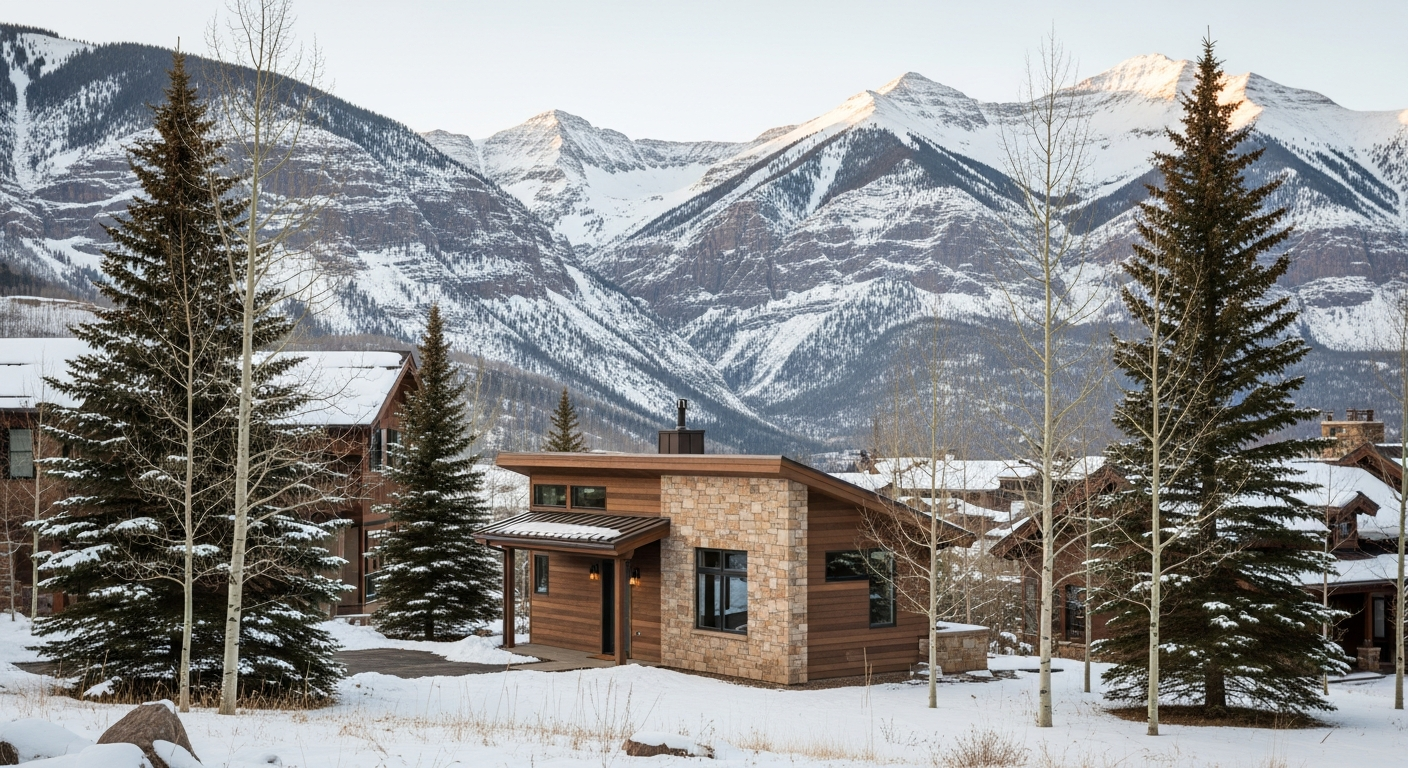
Integration with the primary residence matters for both code compliance and resale. A detached ADU that complements the primary home in massing, materials, and roof line tends to read as part of the property rather than a standalone outbuilding, which supports appraised value at resale.
How do owners typically finance an ADU?
Financing pathways generally fall into four buckets, and the right pathway depends on the owner's equity position, primary use case, and timeline.
A construction-to-permanent loan funds the build in draws and converts to a fixed-rate mortgage at completion. A home equity line of credit (HELOC) draws against existing equity and is common when the primary residence has substantial equity and the build is smaller. Cash funding shortens timeline and avoids construction loan complexity but ties up liquidity. A renovation-extension product such as a Fannie Mae HomeStyle Renovation loan or an FHA 203(k) wraps the ADU build into the primary mortgage.
This guide does not provide financing advice; specific loan structures, qualification, and tax treatment should be reviewed with a licensed mortgage professional and a tax advisor.
Frequently Asked Questions
Who can own an ADU in Telluride?
Ownership of an ADU in Telluride is tied to the underlying lot. An ADU cannot be sold separately from the primary residence under current local code; both the Town of Telluride and the Town of Mountain Village treat the ADU as accessory to the primary dwelling on the same parcel. Condominiumization of an ADU into a separately conveyable unit is not generally permitted.
Can I short-term rent my Telluride ADU on Airbnb or VRBO?
Short-term rental eligibility for an ADU depends on the jurisdiction, the zone, the unit's status (legal, deed-restricted, or non-conforming), and current licensing rules. The Town of Telluride, the Town of Mountain Village, and San Miguel County each operate separate STR licensing programs, all of which have been revised in recent years. ADUs are not automatically STR-eligible in any of the three. Verify current licensing rules with the specific jurisdiction before relying on short-term rental income.
What is the maximum size of an ADU in Telluride?
Maximum ADU gross floor area is set by the local code applicable to the parcel. The Town of Telluride, the Town of Mountain Village, and San Miguel County each cap ADU size by zone, typically expressed as a fixed square footage or a percentage of the primary residence floor area. Caps generally fall in the range of 800 to 1,200 square feet, with variation by zone. Confirm the specific cap for a given parcel with the relevant planning department.
How long does the ADU permit process take?
A realistic timeline for a Telluride-area ADU permit runs eight to eighteen months from pre-application meeting to certificate of occupancy. Simple basement conversions in straightforward zones run shorter. Detached ADUs in the Historic District, ADUs on parcels requiring well and septic engineering, and ADUs subject to multiple HOA design reviews run longer.
Are Mountain Village ADU rules different from Telluride's?
Yes. Mountain Village is a separately incorporated Colorado town with its own Community Development Code, design review process, and short-term rental licensing program, distinct from the Town of Telluride. Mountain Village also has the Mountain Village Owners Association (MVOA) layer and, in many areas, sub-association covenants. ADU rules in Mountain Village should be confirmed at both the Town and the association level.
Do I need a separate water and sewer tap for an ADU?
Tap requirements vary by jurisdiction and by whether the ADU is attached or detached. In-town ADUs served by municipal utilities typically require tap fees or capacity charges; detached ADUs sometimes require a separate tap. County parcels on well and septic must demonstrate adequate well capacity and an appropriately sized septic system through CDPHE-aligned review. Confirm tap requirements with the relevant utility before budgeting.
How does building an ADU affect property tax?
An ADU adds finished square footage to the parcel's improvements, which the San Miguel County Assessor reassesses at the next valuation cycle. The exact impact depends on the assessor's valuation method, the ADU's square footage and quality, and any applicable residential assessment rate set by Colorado law. Property tax estimates for a planned ADU should be reviewed with the County Assessor or a tax advisor.
Can an ADU be built in the Telluride Historic District?
ADUs in the Telluride Historic District are subject to Historic and Architectural Review Commission (HARC) review in addition to the underlying R-1 or R-2 zoning standards. HARC reviews exterior design, massing, materials, and compatibility with the district's historic character. Detached ADUs in alley locations are common in the historic fabric of town and are reviewable, but the design-review process is part of the timeline and feasibility analysis.
Does HB24-1152 force the Town of Telluride to allow ADUs everywhere?
No. House Bill 24-1152 applies to "subject jurisdictions" defined as municipalities inside a metropolitan planning organization with a population of at least 1,000. The Town of Telluride and the Town of Mountain Village sit below the population threshold and outside the relevant MPO, so the state law does not directly preempt local ADU rules in either town. Source: Colorado General Assembly, HB24-1152 (as_of_date: 2024-05-13).
What is a deed-restricted ADU?
A deed-restricted ADU carries a recorded restriction on the title that controls how the unit can be used. The most common variant in the Telluride region is a workforce-housing restriction requiring occupancy by a qualified local worker, often at restricted rents and with reporting requirements. Deed restrictions run with the land and apply to every future owner; they should be read in full before closing on any property that includes one.
How do I decide whether an ADU pencils on a specific Telluride parcel?
A four-step framework: (1) Zoning — confirm the parcel's zone and which ADU types are allowed; (2) Use case — define how the unit will be used and whether that use is permitted under current rules; (3) Cost — build a realistic budget at $350 to $650 per square foot plus 15 to 25 percent in soft costs; (4) Financing — match the build to the right loan product and the owner's equity position. A unit that clears all four steps is the configuration that most often pencils.
Working with a local Telluride broker on ADU questions
ADU questions come up on a meaningful share of properties in the Telluride region. Whether you are buying a property with an existing ADU, evaluating a parcel where an ADU might be added, or trying to understand how a deed-restricted unit changes the buyer pool at resale, the local code layer is the controlling factor. Reading the Town of Telluride Land Use Code, the Mountain Village Community Development Code, and the San Miguel County Land Use Code for the specific parcel is the work that prevents surprises after closing.
Mountain Rose Realty walks the Telluride region directly, including the historic Town of Telluride, Mountain Village, the mesas, and the surrounding San Juan Mountains. Our ADUs in Telluride overview covers deed restrictions, short-term rental treatment, and resale value. For current Telluride and Mountain Village listings and broker introductions, visit the About page.
Anne-Britt Østlund is the broker-owner of Mountain Rose Realty, a member of REALM Global, and affiliated with the Institute for Luxury Home Marketing. Reach her at (970) 759-4886 or ab@mountainrose.co. This guide is informational and does not constitute legal or financial advice; for legal questions consult a Colorado attorney, and for cost specifics consult a licensed Telluride-area builder.