
Luxury Ranch Properties Near Telluride: A Buyer's Guide
Luxury ranch properties in the Telluride region are located not within the Town of Telluride itself, but across the surrounding mesas, valleys, and outlying areas of San Miguel and Ouray Counties. The Town sits on the floor of a box canyon with no developable ranch land inside its grid; the ranch inventory lives on the high mesas above the canyon, in the river-valley corridors down the San Miguel, and across the broader Ouray County landscape to the north. The category spans several distinct property types — trophy ranches on hundreds of acres, smaller equestrian properties, recreational acreage, and river-valley parcels at lower elevation. Across all of them, two due-diligence items dominate the conversation: water rights and conservation easements, both governed by Colorado-specific rules that surprise out-of-state buyers. This guide walks through the geography, the property types, the legal items that matter most, and the off-market dynamic that handles a meaningful share of trophy-ranch transactions here.
Where the Ranches Actually Are
The Town of Telluride sits at roughly 8,750 feet on the floor of a box canyon, ringed by 13,000-foot peaks of the San Juan Range. The developed floor is the historic town grid plus a narrow strip of homes on either side. There is no ranch land in the Town and there cannot be — the geography will not allow it. The ranch inventory in this region is on the mesas, the valleys, and the outlying areas around the Town, distributed across two counties.
Heading north out of the canyon, the road climbs onto a series of high mesas between Telluride and Ridgway. Wilson Mesa runs along the southwestern flank of the Wilson Mountains and holds a meaningful share of the larger-acreage parcels in San Miguel County, with long views toward the Wilson and San Sophia ranges. Hastings Mesa sits south of Wilson Mesa near the head of Last Dollar Road, the dramatic high-mesa drive connecting the Telluride area to Ridgway by dirt road in the warmer months. Specie Mesa, northwest of Telluride above Placerville, is another concentration of mesa-top acreage.
West of Telluride, the San Miguel River drops in elevation. Iron Springs Mesa sits above Placerville. Brown Ranch Road and the broader Down Valley corridor around Placerville hold river-valley ranches at lower elevation — roughly 6,500 to 7,500 feet — with milder weather, longer growing seasons, and San Miguel River frontage in places. Further west, the Norwood-area mesas open into more traditional Western Colorado ranch country.
To the north, Ouray County adds another layer. The Ridgway / Pleasant Valley corridor runs north toward Ridgway and the Uncompahgre River valley. Ralph Lauren's Double RL Ranch is in this corridor — a notable private ranch in the broader region, though it sits well north of Telluride proper, not adjacent. Further out, the Lone Cone area near the Dolores County line offers remote acreage with views of Lone Cone Peak.
Every ranch in this market is roughly fifteen minutes to an hour from the Town of Telluride — some a short drive down the canyon, others over a pass and into the next valley.
Categories of Ranch Property
The Telluride-area ranch market is not one product; it is several, and the right category depends on how the buyer intends to use the land.
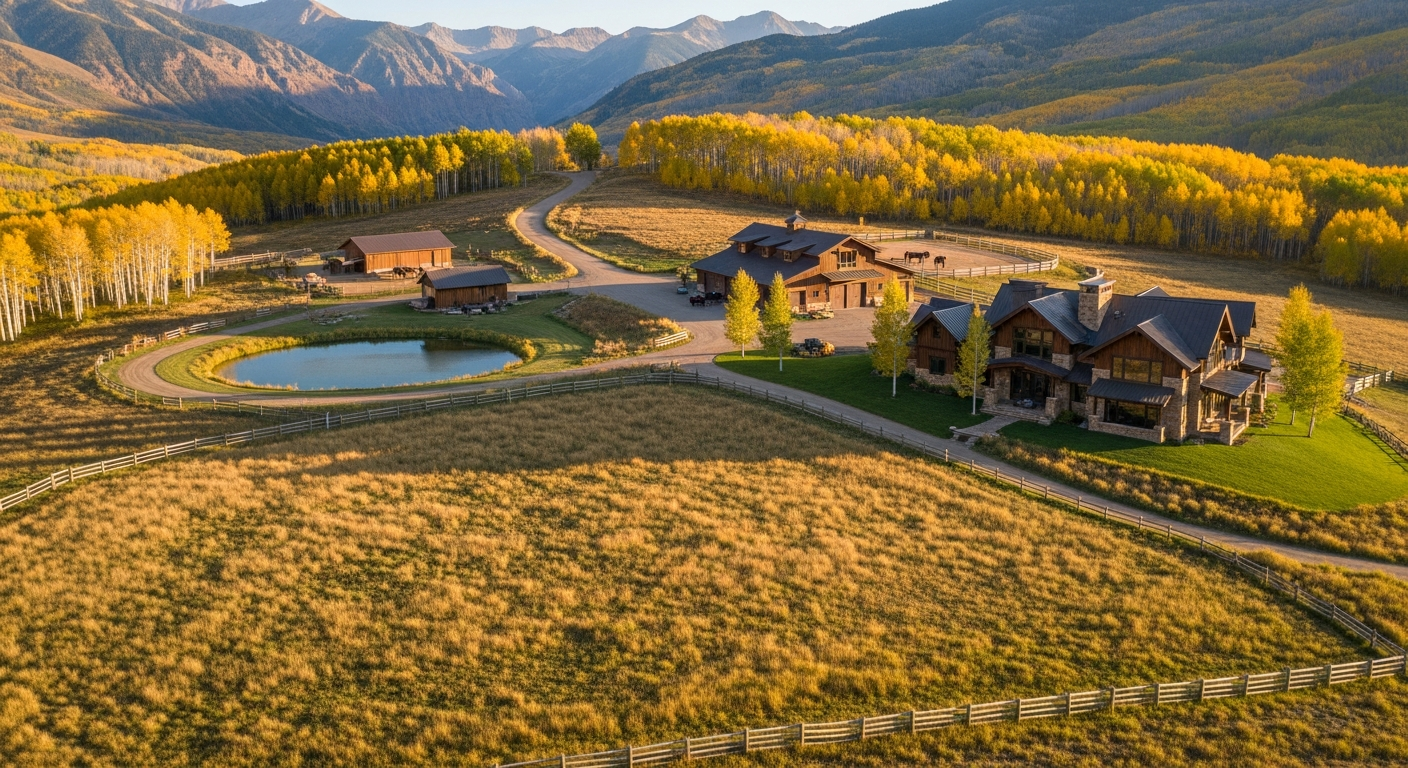
Trophy ranches are the largest parcels — typically a hundred acres or more, often several hundred. They tend to carry meaningful water rights, hay meadows, fenced pastures, and frequently a conservation easement. Improvements range from a single main residence on a working ranch to a full compound with main house, guest houses, manager's quarters, and outbuildings. Trophy ranches command serious prices, and the most desirable of them transact through private channels as often as through the public MLS.
Equestrian properties are smaller — generally five to forty acres — and built specifically around horses. The improvements are the point: barns, paddocks, riding arenas, tack rooms, often direct access to riding trails. Many sit on the lower mesas or in the river-valley areas where pasture is reasonable and veterinary and farrier services are practical. Equestrian buyers evaluate these on the equine infrastructure as much as the residence itself.
Recreational acreage describes properties bought primarily for use, not working agriculture. The residence may be modest; the value is in the land — fishing access, hunting on a forested parcel, hiking and snowmobiling from your own gate. Parcels adjacent to USFS or BLM land effectively extend usable acreage beyond the deed boundary.
River-valley ranches are the lower-elevation category, generally in the Down Valley corridor around Placerville. Elevation is roughly 6,500 to 7,500 feet, winters are milder than on the mesas above, and the growing season is longer. River frontage is the headline asset. These parcels generally trade at a different price-per-acre profile than mesa-view trophy ranches of comparable size — less elevation and less of the iconic high-mesa view, in exchange for usability and weather.
High-mesa ranches — Wilson, Hastings, Specie, and Iron Springs — are the opposite trade-off. Elevation in the 8,000 to 9,000 foot range, longer winters, real road-maintenance considerations, and in exchange the views and privacy that draw most buyers to this market in the first place.
Water Rights: The Single Most Important Item
If a buyer takes one thing from this guide, it is this: in Colorado, water rights are not part of land ownership by default. They are a separate property right, governed by a prior-appropriation system, and they may or may not convey with a particular ranch sale. This is the single most important due-diligence item for any Colorado ranch purchase, and the item out-of-state buyers most often underestimate.
Colorado is a prior-appropriation state, summarized as "first in time, first in right." A water right is established by putting water to beneficial use on a particular date, and that priority date determines who gets water in a dry year. A senior right gets water before a junior right. In a tight year on a fully appropriated stream — and most San Miguel and Uncompahgre tributaries are fully appropriated — junior rights can be called out and may receive no water at all.
Water rights also come in several flavors. Surface rights (creek, river, or ditch diversions) and groundwater rights (wells) are governed differently. Irrigation rights are different from domestic or stock rights — the decreed use is the use allowed. Adjudicated rights have been confirmed through Colorado's water court; unadjudicated claims are weaker.
The practical implication is straightforward. A hay meadow without irrigation rights is dry grass. A pasture with senior agricultural water rights, an intact ditch, and a clean adjudication is a meaningfully different — and more valuable — property than the same acreage without. Always ask, in writing: what water rights convey, what is the priority date, what is the decreed use, what is the historical use, and is the right adjudicated. The deed, title work, and water-court decrees are the source documents, and a Colorado water attorney is the right professional to interpret them if anything is ambiguous. This is not an area where buyer assumption is safe.
Conservation Easements
A conservation easement is a permanent, recorded restriction on a property's deed that limits future development in exchange for tax benefits at the time the easement is placed. The restriction is donated (or sometimes sold) by a landowner to a qualified land trust, and once recorded, the easement runs with the land — it survives every subsequent sale, in perpetuity. The next owner inherits exactly the same restrictions the original donor accepted.
In the Telluride and Ouray County region, a significant share of larger ranches carry conservation easements. The two organizations most often involved are the San Miguel Conservation Foundation and Colorado Open Lands, both Colorado-based land trusts active in the western part of the state. There are others. The specific easement holder matters because the holder monitors compliance going forward, and the relationship the future owner has with that organization is part of the practical reality of owning the property.
What the easement allows and disallows is property-specific and is spelled out in the recorded document. Common provisions limit subdivision (often to a single residence on the entire parcel, sometimes with a defined building envelope), restrict commercial development, prohibit mining, and protect a specific viewshed or wildlife corridor. Many easements allow continued agricultural use, a single residence and accessory outbuildings within a defined envelope, fence maintenance, and standard ranch operations. Some allow a guest house; some do not. Some cap barn square footage; some do not. The only way to know is to read the document.
For buyers, the easement is not automatically a negative or a positive — it is a feature. Some buyers actively prefer easement-protected ranches because the surrounding viewshed and rural character cannot be developed. Others find the building restrictions limiting. Either reaction is reasonable. The mistake is to discover after closing that the easement disallows something the buyer assumed was permitted. Read the easement before writing the offer, and have a Colorado real-estate attorney familiar with conservation easements review it alongside the title work.
Access, Zoning, Wildfire, and Mineral Rights
Four shorter items, each of which deserves a direct look during ranch due diligence.
Access. Many ranch parcels are reached by private roads, shared roads governed by a road-maintenance agreement, or an access easement across an adjacent property. Verify that legal access — recorded in the title chain — exists, that the easement covers the use the buyer intends, and that maintenance responsibility is clear. Then verify physical access in every season. A mesa road that is straightforward in July may require a serious snow-removal plan from November through April. Ask how the current owner reaches the property in February.
Zoning. Most ranch land in San Miguel and Ouray Counties is zoned agricultural, not residential. Building rights on agricultural parcels are generally favorable — a primary residence, outbuildings, and barns are typically allowed — but specifics vary by county and zone. A buyer planning a main residence, a guest house, a barn, and a manager's cabin should verify with the county planning department what the parcel actually allows. Conservation easements layer on top of zoning and may be more restrictive.
Wildfire exposure has become a real consideration at mesa elevations across the West. Forested parcels and mesa-top properties surrounded by sage and grass carry meaningful fire risk. Defensible-space requirements and the availability and cost of homeowner's insurance are all real items to evaluate. Some carriers have pulled out of high-risk Western markets; others write only with significant deductibles. Price coverage before the inspection contingency ends, not after.
Mineral rights. In parts of Western Colorado, mineral rights have been severed from surface rights at some point in the title chain, meaning the surface owner does not own what is below the ground. Large ranch parcels here are not typically subject to active mineral development, but the rights matter — verify what conveys. The title commitment will identify any severed mineral interests of record.
Why People Buy Telluride-Area Ranches
Buyers of Telluride-area ranches are self-selecting into a specific lifestyle, and most are clear about which version they want.
Privacy is the most common driver. A hundred-acre mesa parcel with a conservation easement on the surrounding land is genuinely remote — not "low-density subdivision" remote, but actually remote. For buyers who want a place where the nearest other house is out of sight, this market delivers at a level few others do.
Equestrian and working-ranch use is the second category. Buyers who keep horses, run a small cattle operation, or want a property that functions as a working ranch find genuine inventory here, both in the smaller equestrian range and at the trophy scale.
Recreation — hunting, fishing, hiking, snowmobiling — is the third. Properties adjacent to USFS and BLM land effectively extend the buyer's playground well beyond the deed boundary.
Legacy and family compound purchases are a fourth pattern, and conservation-minded ownership is a fifth — buyers who specifically want to maintain a conservation easement and own land they intend to protect from development in perpetuity.
The sixth driver is simpler: more land for the money than in-town Telluride. On a per-acre basis, ranch land in the surrounding mesas trades at a discount to land inside the Town grid. Trophy ranches still command serious prices, but for buyers who want significant acreage as the headline feature, the mesa and valley inventory is where that is structurally available.
The Off-Market Reality
A meaningful share of legitimate trophy-ranch transactions in the Telluride and Ouray County region happen off-market. Old families do not list publicly. Conservation-easement-protected properties are frequently sold privately to vetted buyers introduced by trusted brokers. At this property tier sellers value privacy, the buyer pool is small, and the public-listing process can attract attention the seller does not want.
Working only the public portals — the MLS, Zillow, Redfin — will miss part of what is actually available. The publicly listed inventory is real and worth working, but a buyer serious about the upper tier should also be in a position to see properties that never appear on a portal. That requires being connected, through a local broker, to the network that handles those private introductions.
At Mountain Rose Realty we work the Telluride region directly, including the surrounding ranch areas, and we have access to that off-market network through long-standing local relationships and our membership in REALM Global. The point is not that off-market inventory is automatically better — it is not. The point is that a buyer at this tier should be in a position to see all of it, public and private, before making a decision.
Working with a Local Broker
At Mountain Rose Realty we work the Telluride region directly — the historic Town, Mountain Village, the surrounding mesas, and the ranch areas of San Miguel and Ouray Counties — and we have direct access to the off-market network that handles a meaningful share of upper-tier ranch transactions here. Anne-Britt Ostlund is the broker-owner of Mountain Rose Realty, a member of REALM Global, and affiliated with the Institute for Luxury Home Marketing, with more than 23 years working the Telluride market and more than $150 million in closed transactions.
If you are evaluating a ranch purchase in the region, we are happy to walk through the geography, the water-rights and easement diligence, and the off-market inventory honestly. There is no obligation in talking through your goals. Reach Anne-Britt at (970) 759-4886 or visit mountainroserealty.co.