Mountain Village vs Town of Telluride: Which Should You Buy?
Mountain Village and the Town of Telluride are two separately incorporated towns about 750 feet apart in elevation, connected by a free public gondola. From the outside they are often spoken of as one place — "Telluride" — but they are governed independently, built in different eras, and behave as distinct buyer markets. The historic Town of Telluride sits on the floor of a box canyon at roughly 8,750 feet, a preserved Victorian mining town inside a National Historic Landmark District. Mountain Village sits at roughly 9,500 feet on the ski-mountain side, master-planned in the 1980s and incorporated as its own town in 1995. Buyers comparing the two are usually choosing between two genuinely different lifestyles, not two flavors of the same one. This guide walks through the geography, the property types, the day-to-day rhythm, and the trade-offs that tend to decide it.
Two Towns, One Gondola
The first thing to understand about this comparison is that Mountain Village and the Town of Telluride are not neighborhoods of a single municipality. They are two separately incorporated Colorado towns, each with its own mayor, town council, planning office, building department, and set of ordinances. Mountain Village was master-planned beginning in the 1980s and incorporated as a town in 1995, which makes it one of the youngest incorporated municipalities in the region. The Town of Telluride was founded in the 1878 mining boom and its historic core was designated a National Historic Landmark District in 1961. The two share a county — San Miguel — a school district, a ski mountain, and a gondola. They do not share regulations, character, or pricing logic.
The free public gondola is the connective tissue. It runs year-round and is the primary commuter link between the two towns, carrying skiers, residents, restaurant staff, and visitors over the ridge that separates the canyon floor from the ski-mountain side. For owners in either town, the gondola materially expands what daily life looks like. A Town homeowner can ride up to ski without driving. A Mountain Village homeowner can ride down to a Town restaurant without parking. The presence of a free, public, transit-grade gondola is one of the genuinely unusual features of this market, and it is the reason the two towns can be considered together at all.
Even with the gondola, they behave as distinct markets. The reasons are physical, regulatory, and cultural — and worth unpacking one at a time.
Geography and Built Environment
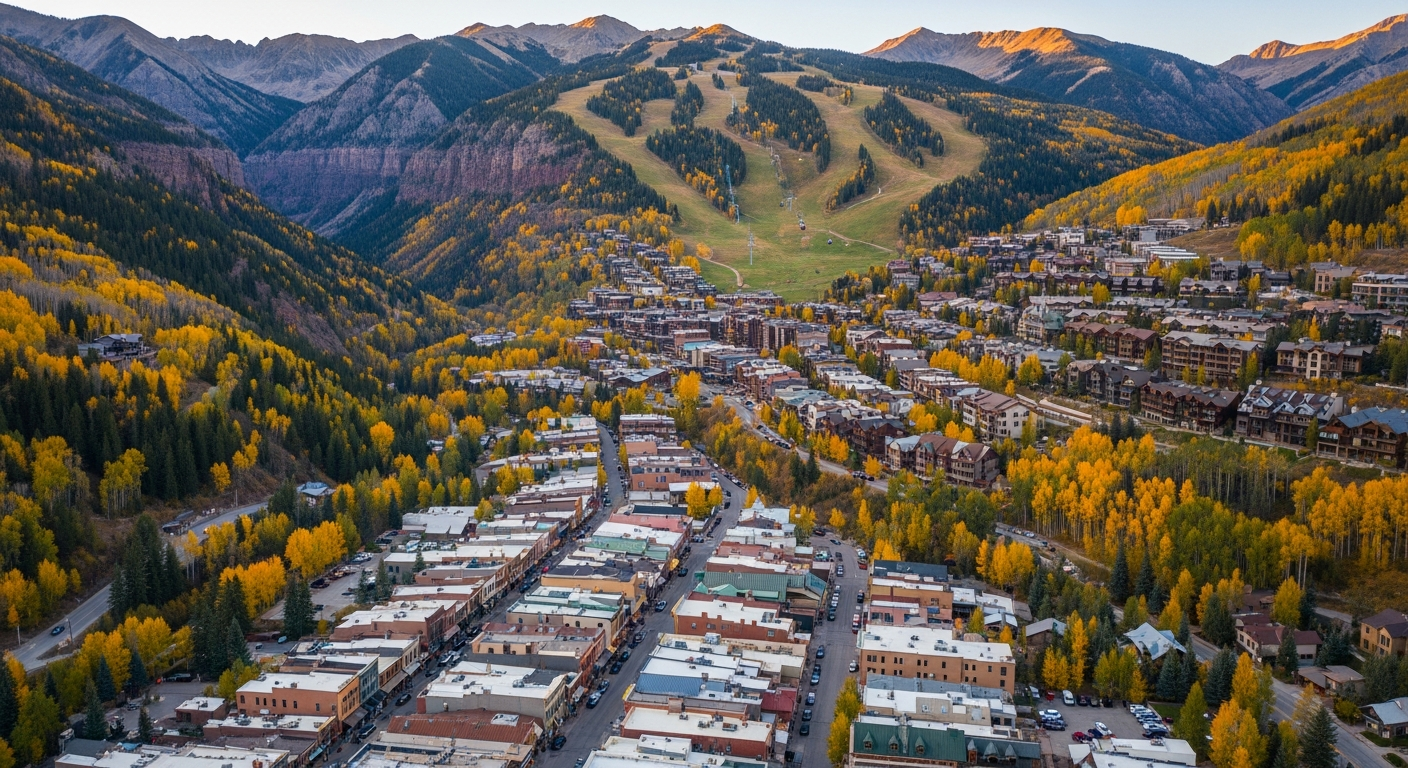
The Town of Telluride occupies the floor of a glacier-carved box canyon, ringed by 13,000-foot peaks of the San Juan Range. Colorado Avenue, the main street, runs east-west on a tight grid and dead-ends at the canyon wall. CO-145 is the only road in or out. Elevation in town is roughly 8,750 feet. The canyon walls climb sharply on the north and south sides, which is part of why there is no room for the town to sprawl outward — Telluride is the size it is because the geography will not allow it to be larger.
That geography is paired with a regulatory layer that further constrains change. The town's historic core was designated a National Historic Landmark District in 1961, and the town's preservation rules are real. Exteriors of historic Victorian homes, the street grid itself, and the visual character of Main Street are protected. New construction inside the district is reviewed against design standards. Even a roof material or a window replacement on a contributing historic structure can be a regulated decision. This is what keeps Telluride looking like Telluride, and it shapes what is buildable on any given lot.
Mountain Village is the opposite story. It sits at roughly 9,500 feet on the south side of the ridge that divides the canyon from the ski mountain's base. Rather than being constrained by an existing 1880s street grid, it was master-planned from a blank canvas in the 1980s — roads, lots, the Village Core, the ski runs, and the resort infrastructure designed together. Lots are larger, building envelopes more generous, and the architectural register newer. Most homes in Mountain Village are less than thirty years old. The visual character is mountain-modern and resort-built rather than restored-historic.
The everyday consequence is straightforward. In Town, you live in a walkable Victorian grid hemmed in by canyon walls, with limited parking and a preserved streetscape. In Mountain Village, you live on a larger lot in a newer home, in a community designed around vehicle access, the ski runs, and the gondola. Two different physical environments, 750 feet apart.
Property Types and Inventory
The property mix in each town is a direct expression of the geography and the era in which it was built.
In the Town of Telluride, the housing stock is anchored by restored Victorians — the 1880s and 1890s mining-era homes lining the residential blocks north and south of Colorado Avenue. Many have been carefully renovated by owners who valued the original architecture and were willing to work inside the historic-preservation framework. Around the Victorians sits a smaller stock of newer infill on city-sized lots inside the existing grid, generally designed to fit the visual character of the district, plus in-town condominiums closer to the gondola plaza. Buildable lots inside the historic town are genuinely scarce; this is a finite inventory, and well-located properties tend to stay tightly held for years or decades.
Mountain Village concentrates the region's ski-in/ski-out and ski-access inventory. The single-family stock includes homes on or directly adjacent to the ski runs — addresses along Carbide Way, See Forever, Russell Drive, Sunset Ridge, and Adams Ranch — alongside larger estate-tier homes throughout the master-planned community. Golf-course property is meaningful here: the Telluride Golf Club runs through the community, with homes along its fairways, and the Peaks Resort area sits at the ski-mountain side of the village. Condominiums and townhomes are a significant share of the Mountain Village market, from convenient ski-base lock-offs to large penthouse residences in the resort-tier buildings.
Pricing in both towns sits firmly inside the luxury tier of the Telluride region. Town historic homes carry what amounts to a Victorian-character premium — there is no way to make more of them. At the upper end of Mountain Village, ski-in/ski-out homes along the most desirable ski runs and the larger estate homes transact at price points that are comparable to, and in some cases higher than, in-town historic homes of similar size. The relevant numbers shift season to season and segment to segment; what is consistent is that both towns participate in the upper end of the regional market, and the question is rarely "which is cheaper" but "what does my budget actually buy in each."
Inventory volume is the more reliable differentiator. The Town of Telluride simply has fewer buildable lots and fewer active listings at any given moment than Mountain Village does — the canyon will not allow otherwise. Mountain Village continues to add new construction on its remaining master-planned parcels and tends to carry a deeper active inventory across its property types. For a buyer who wants choice at a defined moment in time, that depth matters.
Lifestyle and Daily Rhythm
The lifestyle difference between the two towns is the thing most buyers feel before they can articulate it.
In the Town of Telluride, life happens on foot. You can walk from your front door to a coffee shop, a gallery, dinner, a bookstore, and the canyon trail at the east end of Colorado Avenue without moving your car. The town has a year-round residential rhythm — a regular cadence of locals, kids walking to school, restaurants that open in shoulder season — that is distinct from the seasonal pulse of a pure resort base. When the major festivals roll through — Telluride Film Festival, the Telluride Bluegrass Festival, Mountainfilm — they happen at your doorstep. You hear the music from your porch. You bump into the filmmakers at the coffee counter. The original architecture is part of the daily experience: a 140-year-old Victorian streetscape is not a backdrop, it is the place you live.
Mountain Village runs at a different tempo. The ski-day convenience is what defines it. If your home is ski-in/ski-out or a short walk to a lift, the difference in winter is real — you click out of your skis at the door, the boots come off in your own mudroom, and you do not load a car. The garages are bigger, the storage more generous, the snow management more designed-in. The pace at night is quieter than in Town; restaurants and bars exist in the Village Core, but the volume of street-level activity is lower than on a Telluride summer Friday. The gondola gives you Town access without the parking problem when you want it.
The wardrobe cliché — Patagonia on the canyon floor versus a ski pole at the door — captures something real, but it oversimplifies. Both towns are full of serious skiers and serious art lovers; the difference is which one is structurally closer to your daily life. A Town home puts the festivals, the galleries, the original architecture, and the walking-life at your door. A Mountain Village home puts the lift, the larger lot, the newer construction, and the quieter night at yours. Most buyers, once they have spent a few weeks in each, know which fits the way they actually use a mountain home.
Schools
For families, the school question is one of the simpler parts of this comparison. The Telluride School District R-1 serves both the Town of Telluride and Mountain Village. The public schools — Telluride Elementary, Telluride Intermediate and Middle School, and Telluride High School — draw students from both towns, and the district itself does not zone the towns into separate feeder patterns the way larger metropolitan districts do. A child living in Mountain Village and a child living in Town generally attend the same schools.
In addition to the public district, the Telluride Mountain School is an independent option that draws students from across the region. For families weighing the two towns specifically on K-12 grounds, the school decision usually does not differentiate between Mountain Village and Town. Commutes differ — the gondola is a daily reality for many families — but the schools themselves are shared.
Short-Term Rental and Ownership Rules
The towns differ meaningfully on short-term rental regulations, and this is one of the genuinely consequential parts of the decision for buyers who plan to rent. The honest answer is that short-term rental rules are not the same in the Town of Telluride and Mountain Village, and they have evolved over recent years. Both towns have moved on licensing, caps, and restrictions in ways that have changed the calculus for owner-rental strategies. Specifics shift, and what is true at the moment a buyer signs a contract may not match what was true a year earlier. Buyers should verify the current rules with our team or directly with each town's planning and licensing office before underwriting a property on rental income.
Homeowners association dues are the other ongoing cost worth flagging. Mountain Village HOAs can be substantial. The master-planned community supports amenities — landscaping, snow removal, road maintenance, resort infrastructure — that show up in monthly or quarterly assessments, and individual condominium and townhome buildings carry their own dues on top. In the Town of Telluride, fewer properties are governed by HOAs at all; most historic single-family homes are not. For both towns, San Miguel County's property-tax structure is the same — they are inside the same county — but assessed values vary by property and HOA dues vary widely by building and community.
Which Town Fits Which Buyer
The honest version of the comparison is that the right town depends on the buyer's profile, and both choices are defensible.
Lean toward the Town of Telluride if you want a walkable, original-architecture lifestyle with restaurants, galleries, and the canyon trail at your doorstep; if you value living inside a preserved historic district and are willing to work inside the constraints that come with it; if smaller-lot, in-town historic character is more interesting to you than larger-lot new construction; if you want the festivals to happen at your front door rather than at the other end of a gondola ride; and if a year-round residential rhythm — a real town, not a resort base — is part of what you want from a Colorado home.
Lean toward Mountain Village if ski-day convenience is structurally important to how you will use the home; if you want a larger lot, a larger home, more garage and storage capacity, and the newer construction stock typical of the master-planned community; if golf-course living is part of what you are looking for; if a quieter night and a more resort-shaped community fit how you actually spend evenings; if you value the option of new construction or recently built homes; and if the gondola, rather than the front door, is your link to Town life.
Plenty of buyers find that either town would work, and the decision comes down to a specific property — a particular Victorian, a particular ski-run home, a particular building. That is also a reasonable place to land. We work both towns directly at Mountain Rose Realty and would rather walk a buyer through the trade-offs honestly than push one over the other.
Working with a Local Broker
At Mountain Rose Realty we work both the Town of Telluride and Mountain Village directly, alongside the mesa, ranch, and down-valley communities of the surrounding San Juans. Anne-Britt Ostlund is the broker-owner of Mountain Rose Realty, a member of REALM Global, and affiliated with the Institute for Luxury Home Marketing, with more than 23 years working the Telluride market and more than $150 million in closed transactions.
If you are weighing Mountain Village against the Town of Telluride — or trying to decide whether either is the right fit for how you actually want to use a Colorado home — we are happy to walk through the trade-offs honestly. There is no obligation in simply talking through your goals. Reach Anne-Britt directly at (970) 759-4886 or visit mountainroserealty.co.