
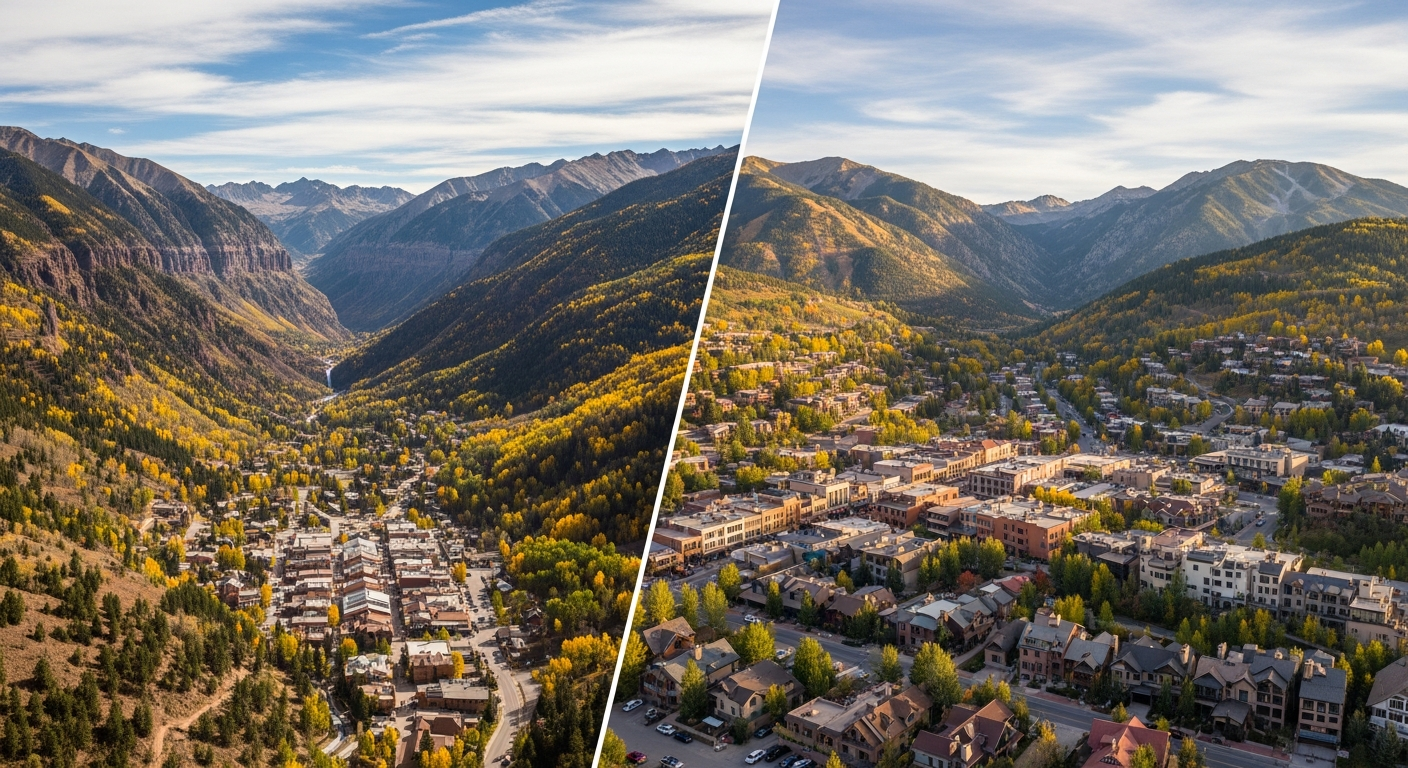
Telluride vs Aspen Real Estate: A Buyer's Comparison
Telluride and Aspen are Colorado's two most prominent luxury mountain real estate markets, but they differ meaningfully in scale, character, and access. Aspen is the larger, more international market — deeper inventory, more commercial flight access, a more visible celebrity and global-buyer presence, and a longer history at the very top of U.S. resort pricing. Telluride is smaller, more geographically constrained, and more deliberately under-the-radar — a box-canyon town with a single road in, a tighter pool of inventory, and a private, network-driven upper market. Both are ultra-luxury second-home markets in the same state, with comparable property-tax treatment and similar buyer profiles at the entry tier. They diverge in what they feel like to live in, what is realistically available, and how the upper end of each market actually transacts. This guide walks through each axis of the comparison so you can decide which fits your goals.
Geography and Access
The most concrete difference between the two markets is the land itself. Telluride sits at the eastern end of a literal box canyon at about 8,750 feet, ringed by 13,000-foot peaks of the San Juan Range. Colorado Avenue, the main street, dead-ends at the canyon wall. CO-145 is the only road in or out. That geography sets a hard ceiling on how much in-town inventory can ever exist and shapes the character of the place — you do not pass through Telluride on the way to anywhere else.
Aspen sits in the Roaring Fork Valley, a more open river valley running northwest from the Elk Mountains toward Glenwood Springs. CO-82 is the primary route, but the valley itself is broad, the surrounding communities (Snowmass Village, Basalt, Carbondale) are continuous, and the developable footprint is meaningfully larger.
Air access reinforces the contrast. Aspen is served by Sardy Field (ASE), a commercial airport inside the town's footprint with seasonal direct service from a number of major U.S. cities. For many buyers that means a single flight, often nonstop, from the East Coast or the West Coast. Telluride has its own regional airport (TEX) at the top of the mesa, used primarily for private and charter traffic, plus Montrose Regional (MTJ) about 65 miles north for commercial flights. From most major cities, reaching Telluride is a longer trip — a connecting commercial flight plus a roughly 75- to 90-minute mountain drive, or a direct private flight into TEX when weather permits.
The "harder to get to" reality of Telluride is a real consideration for buyers who travel weekly. It is also, for a particular kind of owner, exactly the point. Limited access is part of what keeps Telluride smaller and quieter than its peer markets.
Market Size and Inventory
Aspen is a substantially larger real estate market than Telluride by almost any measure: total transactions, dollar volume, depth at the top tier, and turnover. There are more homes, more condos, more estate properties, and consistently more listings on the market at any given time. For a buyer who wants to see ten serious options inside a defined window, Aspen makes that easier.
Telluride is, by design and by geography, a small market. The historic town is finite. Mountain Village is master-planned with defined buildable parcels. The mesa and ranch areas have meaningful inventory but are not infinite. In any given season, the realistic active-listing count across the region is a fraction of what is available in the Aspen/Snowmass area. Velocity is slower, hold periods are longer, and the same well-located in-town Victorian or ski-in/ski-out property can stay tightly held for decades.
What that means in practice is straightforward. In Aspen, a buyer can usually expect to find multiple homes that fit a defined brief and to face competition from other qualified buyers on the strongest of them. In Telluride, the same defined brief might surface one or two genuine candidates at a time — and patience becomes part of the strategy. Telluride buyers who arrive with a narrow checklist often wait. Telluride buyers who arrive with flexibility on neighborhood, property type, or season tend to find what they want sooner.
Neither pattern is inherently better. They suit different buyers. A buyer who wants to move decisively and choose from a known set will find Aspen's depth a real advantage. A buyer who is willing to wait for the right property in a smaller pool will find Telluride's scarcity rewarded over time.
Price Tier
Both markets sit at the top of the Colorado real estate ladder, and both routinely transact at price points well into the eight figures. Aspen has historically commanded higher absolute prices than Telluride at comparable tiers — the $25 million-plus segment in Aspen is broader, more visible, and more regularly transacted, and the very top of the Aspen market has set Colorado records on a recurring basis. Telluride participates in that ultra-luxury tier as well, but with thinner public volume at the very top.
For buyers comparing the two markets head-to-head at a given budget, the practical question is what that budget buys. At comparable price points, Telluride has historically offered more — more land, more interior square footage, or a more in-town location for the same money — than the most sought-after pockets of Aspen. That is a directional statement, not a guarantee on any specific property: the right home in the right Aspen location can outpace anything in Telluride, and vice versa. But for buyers who care about value-per-dollar inside the luxury tier, the comparison is worth running on individual properties rather than at the headline level.
Carrying costs, HOA dues, and renovation pricing run high in both markets — these are remote mountain towns with constrained labor pools, and that shows up in everything from a roof replacement to a kitchen remodel.
Character and Lifestyle
The most useful way to think about the cultural difference between Aspen and Telluride is the wardrobe a town wears in public. Aspen has a polished, visibly international register — it draws a global celebrity, finance, and Hollywood crowd in season, the restaurant scene is larger and more formal, and the experience of walking the downtown core during peak weeks is closer to a high-end European resort than to a Colorado town. The world comes to Aspen, and Aspen has built itself, deliberately, to receive it.
Telluride is smaller, scrappier, and quieter. The town is a National Historic Landmark District of restored Victorians on a canyon-floor grid. The dress code skews toward functional outdoor gear over runway fashion. There are real restaurants and a serious art and gallery scene, but the overall volume is lower, and a meaningful share of homeowners come precisely because Telluride is not Aspen. The town's posture is independent rather than international.
Both communities are festival towns, and the festival calendars are part of how each market markets itself. Aspen hosts the Aspen Ideas Festival, the Food & Wine Classic, the Aspen Music Festival, and the X Games at Buttermilk, among others — a steady cadence of high-profile, internationally programmed events. Telluride's calendar is anchored by Telluride Film Festival, the Telluride Bluegrass Festival, and Mountainfilm — programming with a strong independent and arts-driven character that tends to draw a different audience.
The self-selection effect is real. Buyers who value visibility, the largest possible event calendar, and the international scene gravitate toward Aspen. Buyers who value privacy, a smaller-town feel, and a more outdoor-and-arts-driven culture gravitate toward Telluride. Neither is the correct answer; they are different products.
Skiing
For buyers whose primary use of the home is skiing, the difference in ski product is worth understanding.
Aspen Skiing Company operates four mountains on a single pass: Aspen Mountain (Ajax), Aspen Highlands, Buttermilk, and Snowmass. The four are connected by a free shuttle system rather than by lifts, but a season pass or day ticket grants access to all of them. The variety is real — Snowmass is a large, family-friendly mountain with significant intermediate terrain; Aspen Highlands offers some of the most demanding inbounds skiing in Colorado, including the hike to Highland Bowl; Ajax is the in-town mountain with no beginner terrain; Buttermilk is the learning and terrain-park mountain. Owners who like variety inside a single season pass appreciate the range.
Telluride Ski Resort is a single ski area, with terrain that descends both toward the Town of Telluride on the north side and toward Mountain Village on the south side. A free public gondola — unusual among American ski resorts in being part of the public-transit system — connects the two sides over the ridge. The terrain runs from beginner-friendly intermediates on the Mountain Village side to demanding hike-to and steep terrain like Gold Hill, See Forever, and the Palmyra Peak hike. For owners who want one mountain to know intimately, Telluride is easier to learn well. For owners who want four mountains to rotate through, Aspen's pass offers more variety.
Property Types
Aspen and Telluride share the same broad property categories — in-town homes, condos, ski-access properties, and ranch land — but the mix and the relative weight of each category differ.
Aspen's mix is unusually deep at the downtown-condominium and estate-home tiers. The Aspen core has a robust market in luxury condominiums, often in mid-rise buildings within easy walk of restaurants and lifts. Aspen and the surrounding Roaring Fork Valley also have a meaningful estate-home segment — large lots in Red Mountain, Starwood, and Woody Creek; large ranches further down-valley toward Old Snowmass. Snowmass Village adds a substantial ski-in/ski-out condominium and home inventory of its own.
Telluride's mix reflects its geography. The Town of Telluride has a stock of restored Victorians inside the National Historic Landmark District, plus a smaller number of newer infill homes on city-sized lots. Mountain Village concentrates the region's ski-in/ski-out homes and golf-course property. The mesa and ranch areas — Aldasoro, the Ski Ranches, Hillside, Wilson Mesa, Hastings Mesa — hold the bulk of the larger-acreage parcels and most of the region's ranch and land inventory. Lawson Hill and other down-valley developments offer more attainable price points, and the surrounding San Juan towns of Ridgway, Ouray, and Placerville add another tier below that.
By buyer type, the rough match-up looks like this. Buyers who want a walk-everywhere downtown-condo lifestyle inside a luxury mountain town will find more depth in Aspen. Buyers who want a restored Victorian inside a small, preserved historic town will find that specifically in Telluride. Ski-in/ski-out is meaningful in both markets — Snowmass on the Aspen side, Mountain Village on the Telluride side — and ranch and large-parcel buyers will find product in both, though the character of the land differs.
The Off-Market Reality
Both Aspen and Telluride have meaningful off-market activity, particularly at the upper tiers. The dynamic is the same in both: at a certain price point, sellers value privacy, and a public listing is sometimes the last step, not the first. Brokers introduce qualified buyers to qualified properties through their networks, and a portion of the highest-end inventory in either market changes hands without ever appearing in the public MLS.
In Telluride the dynamic is particularly pronounced. The market is small, the broker community is tight, the inventory at the top is genuinely limited, and the cadence of off-market introductions is a substantial part of how upper-tier transactions happen. A buyer working only the public portals — Zillow, Redfin, the public MLS feed — will not see the full picture at the upper end of the Telluride market. They will see what is publicly listed, which is real, but they will miss properties that are quietly available to a connected broker.
At Mountain Rose Realty we work the Telluride region directly and have access to that off-market network. For buyers who are serious about the upper tier of the market, that access is part of why local representation matters here in a way that is less true in larger, more transparent markets. The point is not that off-market inventory is automatically better — it isn't. The point is that you should be in a position to see it.
Which Market Fits Which Buyer
If you value direct commercial flights, a deeper public inventory at any given moment, a larger restaurant and event scene, and four ski mountains on one pass, Aspen has real advantages. It is the more international market, the more transparent market, and the deeper market at the very top. A buyer who travels weekly, wants to choose from a wide field, and values being part of a globally visible community will likely find Aspen the better fit.
If you value a smaller, quieter town with a preserved historic core, more privacy at comparable price points, a single ski mountain you can learn deeply, and a broker-driven upper market where patience and connections matter more than speed, Telluride is the more natural fit. A buyer who is willing to make a slightly longer trip in, comfortable with a tighter pool of inventory, and drawn to a more independent culture will find Telluride suits the way they actually want to use the home.
Many buyers consider both. That is a reasonable place to start. The honest answer is that the right market is the one that matches how you will actually spend time in the home — which mountain, which town, which travel cadence, and which neighbors.
Working with a Local Broker
At Mountain Rose Realty we work the Telluride region directly — the historic town, Mountain Village, the mesas, and the surrounding San Juan communities — and we have direct access to the off-market network that handles a meaningful share of upper-tier transactions here. Anne-Britt Ostlund is the broker-owner of Mountain Rose Realty, a member of REALM Global, and affiliated with the Institute for Luxury Home Marketing, with more than 23 years working the Telluride market and more than $150 million in closed transactions.
If you are weighing Telluride against Aspen, or thinking through a Telluride purchase on its own terms, we are happy to walk through the trade-offs honestly. There is no obligation in simply talking through your goals. Reach Anne-Britt directly at (970) 759-4886 or visit mountainroserealty.co.