What It Is Like to Live in Telluride: The Little Switzerland of Colorado
Living in Telluride means waking up at 8,750 feet inside a glacial box canyon in the San Juan Mountains, with the Sneffels Range rising on every side and a working historic downtown at the floor of it. The day-to-day is shaped by altitude, by long winters with around 280 inches of snow at the ski area, and by two distinct communities — the historic Town of Telluride and Mountain Village at 9,545 feet — sharing one school district and one regional airport. Year-round residents number roughly 2,600 in Town and 1,300 in Mountain Village, according to the U.S. Census Bureau's 2020 decennial count.
Why is Telluride called "Little Switzerland of America"?
The "Little Switzerland of America" nickname predates the ski era. It comes from two layered facts: the geography itself, and the people who first settled here.
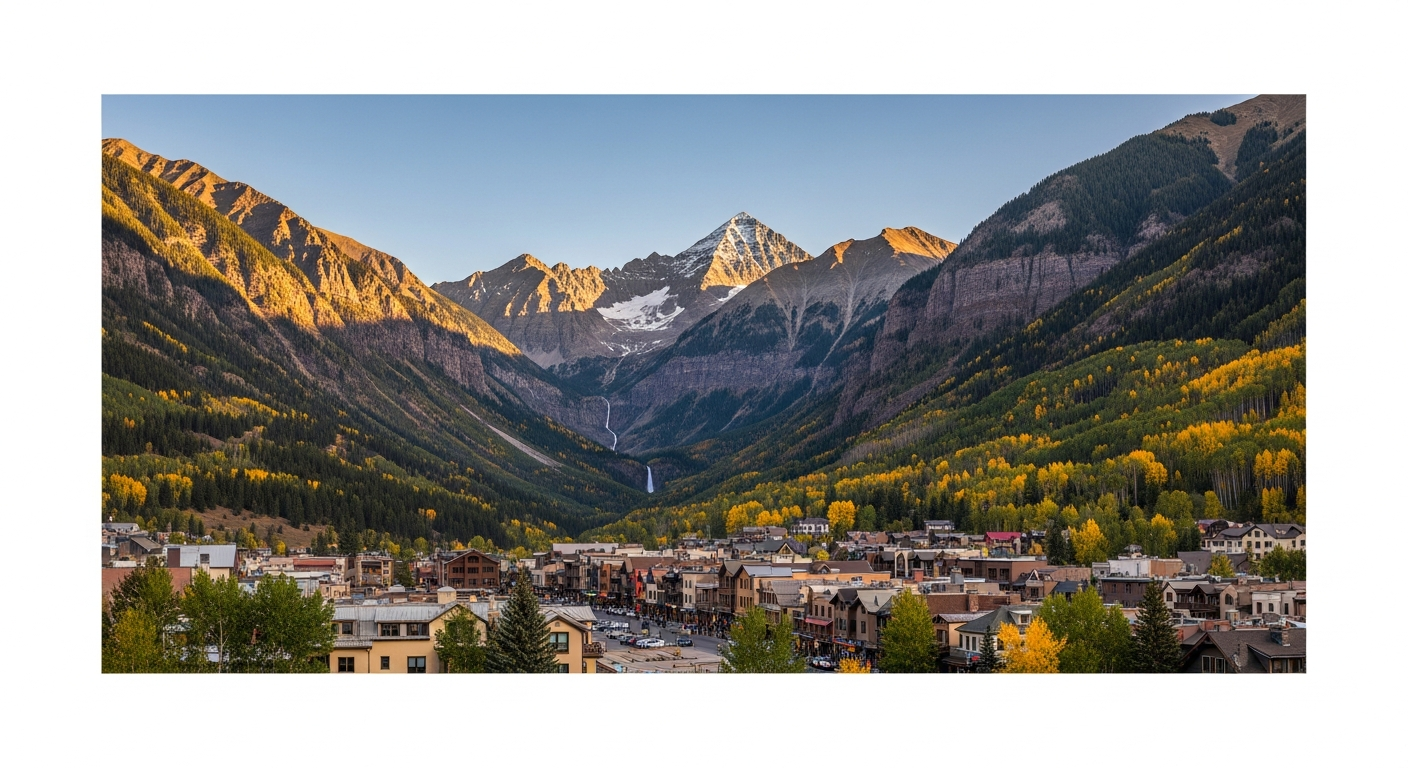
The box canyon at the east end of the San Miguel River valley is geologically Alpine. Three sides of vertical rock close around the town — Ajax Peak, Telluride Peak, and Ballard Mountain — with Bridal Veil Falls dropping 365 feet at the head of the canyon, the tallest free-falling waterfall in Colorado, according to the Colorado Geological Survey. The Sneffels Range and the broader San Juan Mountains form a silhouette that nineteenth-century visitors compared directly to the Bernese Oberland and the Pennine Alps.
The second layer is demographic. Telluride was a hard-rock silver and gold mining town from 1878 onward, and the mining workforce drew heavily from Swiss, Tyrolean, Austrian, and northern Italian miners who had worked the Alpine deposits before crossing the Atlantic. Surnames in the Telluride Historical Museum's archives reflect that pattern. The architecture of early mining-camp lodges, the place-name borrowings, and the alpine farming patterns on the surrounding mesas all carried forward.
Mountain Village extends the comparison deliberately. Master-planned beginning in 1983 and incorporated as a separate Colorado municipality in 1995, the village was designed from the start as an alpine-style ski community in the Tyrolean and Swiss tradition — pitched roofs, stone-and-timber façades, a pedestrian core, and a gondola connecting the two communities. The nickname holds up because the resemblance is structural, not stylistic.
How does the altitude in Telluride actually affect daily life?
Three elevations matter. The Town of Telluride sits at 8,750 feet. Mountain Village sits at 9,545 feet, almost exactly 800 feet higher. The Telluride Ski Resort summit at Palmyra Peak reaches 13,150 feet, with most lift-served terrain between 9,500 and 12,500 feet.
For people relocating from sea level, the physiological transition is real. The Wilderness Medical Society's "Practice Guidelines for the Prevention and Treatment of Acute Altitude Illness" (Luks et al., 2024 update) notes that acute mountain sickness (AMS) is uncommon below 8,000 feet, increasingly common above 8,200 feet, and significantly more common above 9,800 feet. Town of Telluride sits in the middle band; Mountain Village sits at the upper edge of it. The same guidelines describe a typical acclimatization window of several days for resting symptoms and roughly two to six weeks for full physiologic adjustment of red blood cell mass and ventilatory response.
Honest framing matters here. The University of Colorado Anschutz Medical Campus's Altitude Research Center has documented that moderate-altitude residence (roughly 6,500 to 10,000 feet) can unmask underlying conditions in new arrivals — most notably untreated obstructive sleep apnea, undiagnosed pulmonary hypertension, and some cardiovascular conditions. Dehydration accelerates faster than at sea level. Ultraviolet exposure intensifies roughly 7% to 10% per 1,000 feet of elevation gain, according to the U.S. Environmental Protection Agency's SunWise guidance.
For personal health questions, defer to a physician who knows your history. A pre-move altitude consultation with a primary care doctor or pulmonologist is reasonable for anyone with a cardiac, pulmonary, or sleep-related concern, and is what the buyers I work with most often ask about first.
The other side of the ledger deserves equal time. A peer-reviewed analysis published in the Journal of Epidemiology and Community Health (Faeh, Gutzwiller, and Bopp, 2009) found that long-term residents of moderate-altitude Swiss municipalities (1,500 to 2,000 meters, roughly 4,900 to 6,500 feet) showed lower mortality from coronary heart disease and stroke than lowland populations, after adjustment for confounders. A 2014 study in the Journal of the American Heart Association by Faeh et al. extended similar findings to U.S. counties at moderate altitude. The mechanism is debated — possibilities include increased oxidative efficiency, mild erythropoietic conditioning, and reduced ambient particulate exposure — but the population-level signal is consistent. Telluride's elevation places it in the band these studies examined.
What that means in practice: the first two to six weeks are the adjustment period, the long arc tends to be cardiovascularly favorable for healthy adults, and the specific medical picture for any individual is a conversation with a doctor, not with a real estate broker.
What is the climate like in Telluride year-round?
Telluride has four functional seasons, and they do not divide evenly.
Ski season runs late November through early April. The Telluride Ski Resort typically opens around the Wednesday before Thanksgiving and closes the first weekend of April. The resort reports a long-term average of 280 inches of annual snowfall on the upper mountain. The town floor receives less — roughly 175 inches per year — because the box canyon's lower elevation and southern aspect take more of the snow as mixed precipitation, per Colorado Climate Center records for the Telluride 4WNW station.
Mud season runs mid-April through late May. Once the resort closes and before summer trails open, the town empties out noticeably. Many restaurants close for two to four weeks for staff vacations and renovations. This rhythm is not a flaw to be solved; it is the working community's annual reset. Year-round residents plan around it the way coastal residents plan around hurricane season.
Summer runs early June through mid-September. This is the period of around 300 sunny days that gets quoted in marketing materials. The Colorado Climate Center's normals for Telluride confirm 240 to 250 days per year with measurable sunshine, with the highest concentration in June through September. Afternoon thunderstorms are a near-daily summer feature, typically forming between 1 p.m. and 4 p.m. and clearing by evening. Daytime highs in July average in the mid-70s Fahrenheit; overnight lows often drop into the 40s.
Fall transition runs mid-September through late October. Aspen turn (peak gold color in the surrounding aspen groves) typically occurs the last week of September through the first week of October. First measurable snow at town elevation usually arrives in October. Restaurant closures resume briefly in late October and early November before the ski-season ramp.
For full-time residents, the climate's most distinctive feature is not the cold or the snow — it is the seasonality of commerce. A town that runs at full capacity in February and August runs at half capacity in May and November. Knowing which season you are in is part of knowing where to buy groceries, which restaurant is open, and whether the dentist is in town.
Town of Telluride vs Mountain Village: which is better for full-time living?
The two municipalities share a school district (Telluride R-1), a regional airport (Telluride Regional Airport, TEX), and a single hospital (the Telluride Medical Center). They differ on almost everything else that shapes daily life.
Town of Telluride is the historic core: a Victorian mining town founded in 1878, on the U.S. National Register of Historic Places since 1961, with a Historic District that governs exterior alterations and new construction. The street grid is walkable end to end in roughly twenty minutes. Main Street commerce (Colorado Avenue) anchors the town. The full-time population is roughly 2,600, per the 2020 Census. Elevation is 8,750 feet. Architectural restrictions are stricter; HOA exposure is generally lower because much of the historic core is fee-simple ownership without master-planned community dues. The grocery store, post office, library, courthouse, and most of the bars and restaurants are here.
Mountain Village is a separately incorporated Colorado municipality, master-planned and incorporated as a town in 1995. The full-time population is roughly 1,300, per the 2020 Census. Elevation is 9,545 feet. Most residential development is governed by the Mountain Village Owners Association (MVOA), which collects HOA-style dues and operates amenities including the gondola, transit, and a meaningful share of trail and open-space access. Ski-in/ski-out is concentrated here. The gondola — free to ride, operating roughly 6:30 a.m. to midnight — connects Mountain Village to Town in about thirteen minutes, and is the most-photographed piece of municipal infrastructure in San Miguel County.
The trade-off most full-time buyers weigh is walkability versus skiing. Town residents walk to dinner, walk to the post office, and drive to the ski lift (or ride the free gondola). Mountain Village residents ski out the door and drive — or gondola — to most groceries and night life. Families with school-age children split roughly evenly, because both feed the same K-12 schools. Retirees more often pick Town for the walkability and the lower elevation. Active skiers more often pick Mountain Village for the ski access and the newer construction.
A specific note on elevation: the 800-foot difference between 8,750 and 9,545 is not academic. The Wilderness Medical Society guidelines treat that band as the threshold where AMS becomes meaningfully more common. For buyers who have lived at sea level, the lower elevation of Town is the more forgiving acclimation address. For buyers already accustomed to mountain elevations, the elevation difference matters less.
How many people actually live in Telluride year-round?
The full-time population is small relative to the visitor count. Per the U.S. Census Bureau's 2020 decennial count, the Town of Telluride had 2,607 year-round residents and Mountain Village had 1,264, for a combined population of roughly 3,900 across the two municipalities. San Miguel County (which includes the unincorporated mesas, Norwood, Sawpit, Ophir, and Down Valley areas) recorded 8,072 total residents.
Second-home and short-term-rental ownership materially exceeds full-time ownership. The Town of Telluride's 2022 short-term rental study (Town of Telluride Community Development Department) found that approximately 60% of housing units in Town and a meaningfully higher share in Mountain Village were not owner-occupied as primary residences. The practical effect: the on-the-ground population on a December weekend looks five to seven times larger than the resident population. The population on a May Tuesday looks closer to the resident number.
For full-time residents, that ratio is one of the most-discussed facts of daily life. It shapes restaurant staffing, school-district enrollment patterns, the timing of doctor and dentist appointments, and how the community absorbs traffic, parking, and grocery demand across the year.
The 5 questions buyers should answer before committing to a full-time Telluride move
This is the framework I most often walk through with prospective full-time buyers. It is built from the patterns that distinguish successful relocations from the ones that reverse within eighteen months.
1. How is your altitude tolerance, and what does your physician say? A weekend ski trip is not a stress test for full-time living at 8,750 to 9,545 feet. The honest version of this question requires either prior moderate-altitude residence, a physician consult, or a multi-week trial stay in shoulder season. The buyers who do best either already live above 5,000 feet or have specifically cleared the move with a primary care doctor.
2. How do you feel about mud season? Mid-April through late May is the test. Restaurants close, the resort is shut, the trails are wet, and the social calendar empties. Year-round residents either travel during mud season or settle into it as a rest period. Buyers who need year-round commerce and activity often discover the gap is harder than expected.
3. Town walkability or Mountain Village ski-access — which trade do you actually want? The honest answer requires walking both communities in winter and in summer. The decision often comes down to whether the household values dinner-on-foot or ski-on-foot more highly. Both have legitimate buyers; the wrong choice for the household is the most common source of resale within three years.
4. What is your remote-work reality, and what is your travel pattern? Telluride Regional Airport has limited direct service, and Montrose Regional Airport (sixty-five miles north) carries the rest. A buyer who needs to be on a coast monthly should price travel friction into the decision. Reliable broadband is widely available in both Town and Mountain Village, but understanding the carriers and the in-home setup matters.
5. What is your household plan for mid-October and mid-May? The two shoulder seasons are the honest mirror of the move. If the answer is "leave town," the second-home pattern fits. If the answer is "stay and enjoy the quiet," the full-time pattern fits. Many of the most settled long-term residents are the ones who answered question five with "stay" before they moved.
Frequently Asked Questions
Why is Telluride called Little Switzerland?
The nickname combines geography and demographics. The Town of Telluride sits in a glacial box canyon walled by the Sneffels and San Juan ranges, a silhouette nineteenth-century visitors compared directly to the Bernese Oberland. Swiss, Tyrolean, Austrian, and northern Italian miners who had worked the Alpine deposits formed a meaningful share of the 1878-era mining workforce, and Mountain Village was master-planned in the 1980s in the Tyrolean-Swiss alpine-village tradition. The Telluride Historical Museum documents both threads.
How long does it take to acclimate to Telluride's altitude?
Resting symptoms (mild headache, light shortness of breath, sleep disruption) typically resolve within a few days to two weeks for most healthy adults arriving from sea level, per Wilderness Medical Society guidelines. Full physiologic adjustment — including red blood cell mass and ventilatory response — takes roughly two to six weeks. The Town of Telluride at 8,750 feet acclimates faster on average than Mountain Village at 9,545 feet. Individual variation is meaningful, and any pre-existing cardiac, pulmonary, or sleep condition warrants a physician consult before the move.
Can you live in Telluride year-round?
Yes. Roughly 3,900 people live in the two municipalities full-time, split between the Town of Telluride (about 2,463 residents) and Mountain Village (about 1,447 residents), per the U.S. Census Bureau's 2020 decennial count. San Miguel County as a whole reports 8,072 total residents, with the remainder distributed across Norwood, Sawpit, Ophir, Down Valley, and the unincorporated mesas including Aldasoro and Wilson Mesa. The year-round community supports a K-12 school district (Telluride R-1), a community hospital (Telluride Medical Center), a county courthouse, a regional airport (Telluride Regional Airport), and full municipal services in both Town and Mountain Village. Mud season (mid-April through late May) and the late-October shoulder are the practical tests of year-round living — restaurants close for two to four weeks, the ski resort is shut, the trails are wet, and the social calendar empties. Residents either travel during these windows or settle into them as rest periods.
Is Telluride hard for people with respiratory issues?
It depends on the specific condition. Moderate altitude can unmask undiagnosed obstructive sleep apnea, complicate untreated pulmonary hypertension, and add load to advanced COPD. The University of Colorado Anschutz Altitude Research Center documents these patterns. For asthma and mild reactive airway conditions, many residents adapt well. The honest answer is that a pre-move pulmonology consult is appropriate for anyone with a known respiratory condition, and is one of the questions buyers most often ask about first.
What's the difference between Town and Mountain Village for full-time residents?
The Town of Telluride is the historic walkable core at 8,750 feet — Main Street commerce, Victorian architecture, stricter historic-district restrictions, lower HOA exposure, and most of the year-round community amenities (grocery, post office, library, courthouse). Mountain Village is the master-planned alpine community at 9,545 feet — ski-in/ski-out access, the free gondola, Mountain Village Owners Association amenities, newer construction, and a higher second-home share. Both feed the Telluride R-1 school district.
What are the four seasons actually like in Telluride?
Ski season (late November through early April) brings around 280 inches of snow at the resort and the highest commercial activity of the year. Mud season (mid-April through late May) is the working community's reset — restaurants close, the resort is shut, and the town empties. Summer (early June through mid-September) brings around 240 to 250 measurably sunny days per the Colorado Climate Center, daytime highs in the mid-70s, and near-daily afternoon thunderstorms. Fall (mid-September through late October) carries the aspen turn the last week of September and first measurable snow in October.
Living the Year, Not the Weekend
What separates a satisfying Telluride move from a regrettable one is rarely the obvious factors — the ski terrain is excellent, the views are real, the town is genuinely beautiful. The factors that matter are subtler: altitude tolerance, shoulder-season rhythm, the Town-versus-Mountain Village fit, and a household plan that accounts for the off-weeks as honestly as the festival weeks.
The buyers who settle in well tend to be the ones who answered the five questions before the closing, not after.
If you are working through a Telluride or Mountain Village move and want a candid walk-through of how the year actually feels — including which neighborhoods fit which patterns, and where the trade-offs sit — Anne-Britt Østlund is reachable through Mountain Rose Realty at (970) 759-4886. The Telluride community page and the Mountain Village community page cover the on-the-ground specifics in more depth, and the current Telluride and Mountain Village listings reflect what is presently available at each elevation and in each community. For readers comparing Telluride to other Colorado markets, the Telluride versus Aspen guide and the ADUs in Telluride guide cover adjacent decisions buyers commonly weigh alongside the lifestyle questions in this article.
Anne-Britt Østlund is the broker-owner of Mountain Rose Realty in Telluride, Colorado, with more than 23 years working the Telluride and Mountain Village markets. She is a member of REALM Global and the Institute for Luxury Home Marketing. More on her background at mountainroserealty.co/about.
Sources cited: U.S. Census Bureau 2020 Decennial Census; Wilderness Medical Society Practice Guidelines (Luks et al., 2024); University of Colorado Anschutz Altitude Research Center; Colorado Climate Center (Telluride 4WNW station); Colorado Geological Survey; Telluride Historical Museum; Town of Telluride Community Development Department 2022 Short-Term Rental Study; Journal of Epidemiology and Community Health (Faeh, Gutzwiller, Bopp, 2009); Journal of the American Heart Association (Faeh et al., 2014); U.S. Environmental Protection Agency SunWise guidance.