
Mountain Rose Realty — Telluride, Colorado
Rico Colorado Homes for Sale: Local Proof Points Buyers Can... — featured image

Rico Colorado Homes for Sale: Local Proof Points Buyers Can...

10 min read

Rico Colorado Homes for Sale: Local Proof Points Buyers Can Verify

Mountain Rose Realty is a boutique, independent, and unapologetically personal brokerage based in Telluride, Colorado, and Rico sits squarely inside the territory we work every week. If you are evaluating homes for sale in Rico Colorado, the smartest move is to treat every listing detail, from lot boundaries to water rights, as a claim you confirm against county records rather than a fact you accept. This guide gives you the local proof points that matter and the exact steps to check them.

Short Answer

Mountain Rose Realty tracks a Rico market with a 2020 census population of 288 (U.S. Census Bureau via Wikipedia). Homes range from restored 1880s miner's cottages to newer valley-floor builds and scattered patented mining-claim parcels, and inventory is thin because the town is small and much of Dolores County is public land. Buyers face real trade-offs on access, utilities, and winter maintenance at 8,800 feet of elevation (Uncover Colorado). The single most important first step: pull the parcel record and title commitment for any address to confirm boundaries, mining-claim history, and legal access before you write an offer.

What Buyers Should Know About Rico, Colorado Homes for Sale

Mountain Rose Realty notes that Rico is a legally incorporated statutory town in Dolores County, not an unincorporated cluster of cabins, which means town-level rules, utilities, and services apply inside its boundaries in ways they do not for outlying claim parcels. That distinction takes effect the moment you compare an in-town cottage to a mining-claim property up one of the surrounding gulches. The in-town home connects to municipal systems. The outlying parcel relies on a well, a septic system, and a private road you are responsible for maintaining.

Rico was settled in 1879 as a silver-mining center in the Pioneer Mining District (Colorado Encyclopedia / Wikipedia), and that history is not a footnote here. It shows up in the platted town grid, the age of the housing stock, and the patented mining claims that still define ownership lines on the slopes above the valley floor.

The town's small size is the defining market reality. With a 2020 census population of 288 (U.S. Census Bureau via Wikipedia), Rico rarely lists more than a handful of homes at once, so buyers who want a specific style, lot size, or in-town location wait months for the right property rather than choosing from a deep menu.

For a buyer used to Telluride or Mountain Village inventory, that scarcity changes strategy. You monitor a short list and act decisively when a fit appears, rather than touring ten candidates in a weekend. That watch-and-wait approach is exactly what we handle for clients through working with a local agent who covers Rico.

How Rico Compares to Telluride and the Surrounding San Juan Towns

Mountain Rose Realty compares Rico to Telluride the way a working valley town compares to a destination resort: quieter, more affordable per square foot, and far less serviced. Rico is not Telluride, and it is not trying to be. Unlike Telluride and Mountain Village, Rico has no ski resort at its edge, no gondola, and no dense retail core, which is precisely the appeal for buyers who want mountains without the resort machinery.

Against nearby towns, Rico slots into a recognizable San Juan pattern. It shares the mining-town DNA of Silverton and Ophir, the small-population quiet of those places, and the same reality that services thin out as you leave Telluride. Where Ophir sits just off the Telluride side of the pass, Rico is on the far side toward Dolores and Cortez, which reorients your errands, medical access, and airport runs.

Rico's mining-era population once peaked near 5,000 around 1892 (Colorado Encyclopedia / Durango Herald), a startling contrast with today's 288, and that history explains why the town's grid and housing footprint feel larger than the current population would suggest. You are buying into infrastructure originally built for a boomtown.

The practical trade-off is commute and services versus price and solitude. A buyer choosing between Rico and one of the neighborhoods closer to Telluride is really choosing between a longer drive over Lizard Head Pass and the daily convenience of being minutes from town. Neither is wrong; they are different lifestyles, and the pass in January is the honest tiebreaker.

Property Types and Ownership Realities in a High-Altitude Mining Town

Mountain Rose Realty sorts Rico's property types into three practical categories: restored or original in-town homes on the platted grid, newer valley-floor construction, and patented mining-claim parcels on the surrounding slopes. Each carries a different ownership reality, and the category determines your due-diligence checklist more than the price does.

In-town homes are the most straightforward. Because Rico was settled in 1879 as a silver-mining center (Colorado Encyclopedia / Wikipedia), many of these sit on the historic grid with municipal utilities and legal street access, though age brings its own questions about foundations, insulation, and systems built for a different era.

Patented mining-claim parcels are the category that surprises out-of-area buyers. A patented mining claim is private land that was granted out of the federal public domain under old mining law; it is not the same as a standard subdivided lot, and its boundaries can follow the original claim survey rather than a tidy rectangle.

The high-altitude factor cuts across all three types. At 8,800 feet (Uncover Colorado), snow load, freeze protection for water lines, and driveway plowing are not optional considerations, and a home that shows beautifully in July reveals winter access problems in February. If you are weighing raw land or a claim parcel, the same discipline in buying land around Telluride applies with even more force in Rico.

How to Verify Listing Details, Documents, and Land Records by Address

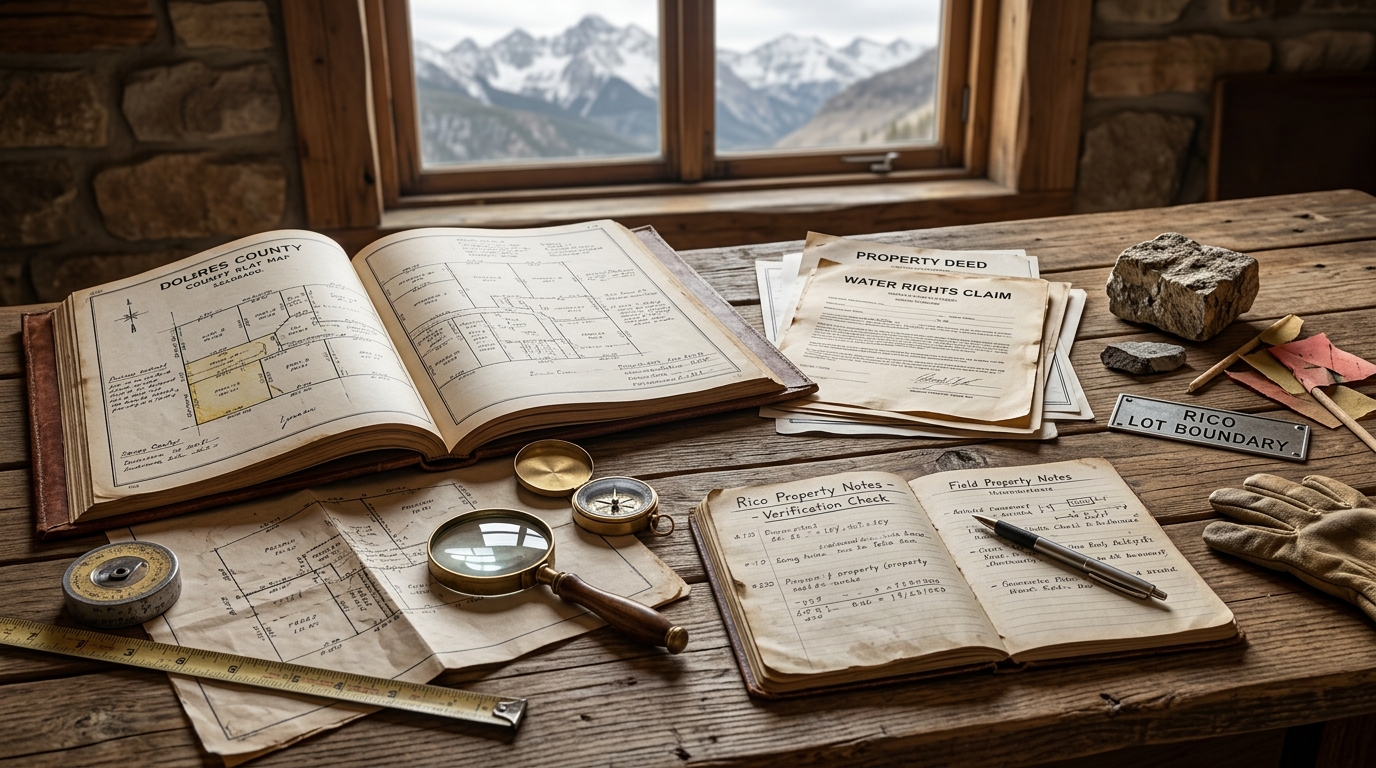
Mountain Rose Realty verifies a Rico listing starting with the Dolores County Assessor and Clerk and Recorder, where you confirm the parcel number, legal description, ownership history, and recorded documents for the exact address before you rely on anything in the MLS write-up. For a town with a 2020 census population of 288 (U.S. Census Bureau via Wikipedia), listing remarks describe a home; county records govern it, and the two do not always match.

For any parcel, order a title commitment early and read the exceptions, not just the summary page. This is where mining-claim boundaries, easements, and access questions surface, and it is the single document that tells you whether the private road to a claim parcel is legally yours to use or a neighbor's courtesy.

Confirm utilities by address, not by assumption. An in-town Rico home connects to municipal water and sewer, while a parcel a half-mile up a gulch needs a permitted well and septic system, so ask for the well permit, septic records, and any shared-well agreements in writing. The Town of Rico and Colorado.gov municipal records are the right places to confirm what serves a given address.

Check legal and physical access separately, because they are not the same thing. A parcel can have a deeded easement on paper and still sit behind a gate or a road that is impassable in winter, which is why walking the access route and reading the recorded easement both belong on your checklist.

Because Rico inventory is thin and each property is idiosyncratic, this address-level verification is the work that protects you. It is also the reason the general discipline in what to weigh before buying a house in this region carries over cleanly to Rico.

What To Verify Before Deciding

Decision factor What to check Where to confirm
Parcel and boundaries Parcel number, legal description, whether it is a platted lot or patented mining claim Dolores County Assessor and Clerk and Recorder
Legal access Recorded easements, deeded road access, shared-road maintenance Title commitment exceptions, recorded documents
Utilities Municipal water/sewer vs. private well and septic; shared-well agreements Town of Rico records, well/septic permits
Winter reality Snow load, plowing responsibility, access road grade at 8,800 ft Site visit, seller disclosures, neighbors
Ownership history Prior transfers, liens, mining-claim history Clerk and Recorder, title work

Working With a Local Agent Who Knows Rico and Dolores County

Mountain Rose Realty covers Rico and Dolores County as part of a service area that includes Mountain Village, Ophir, Silverton, Norwood, Placerville, and Telluride, so the geography here is not a one-off assignment. Anne-Britt Ostlund works this corridor over Lizard Head Pass regularly, which matters because Rico real estate rewards someone who already knows which gulch roads hold snow and which claim parcels have clean access.

A local agent's real value in Rico is document fluency, not just tours.

Mountain Rose Realty is boutique, independent, and unapologetically personal, and that white-glove approach fits Rico specifically because the town's thin inventory demands patience and fast, informed action when the right property appears. This is Lifestyle By Design applied to a real, verifiable market, unique, like you.

Mountain Rose Realty helps buyers weighing both Rico and year-round mountain life understand the daily rhythm first, which is why it helps to read about living in this region year-round alongside your Rico search.

Reviewed for freshness: July 2026.

Work With Anne-Britt Ostlund in Rico

Mountain Rose Realty's Anne-Britt Ostlund helps buyers compare homes and neighborhoods with a practical tour plan. The service area covers Mountain Village, Ophir, Rico, Silverton, Norwood, and Placerville, and the next conversation can turn commute pattern, neighborhood fit, HOA or metro-district tolerance, school-boundary checks, and current inventory into concrete next steps.

Frequently Asked Questions

What makes Rico, Colorado a distinct place to buy a home?

Mountain Rose Realty describes Rico as a small, historic mining town in the San Juan Mountains with a 2020 census population of 288 (U.S. Census Bureau via Wikipedia) that has remained largely unchanged compared to more developed mountain communities. Its scale, quiet character, and surrounding public lands define the lifestyle there, this is not a resort town, and buyers who thrive in Rico typically value that distinction. The practical trade-off is limited commercial infrastructure, so daily conveniences require planning.

How far is Rico from Telluride?

That distance matters practically, it shapes commute times, access to services, and how connected a Rico homeowner feels to Telluride's amenities and employment base.

What is Rico, Colorado's elevation and population?

Rico sits at 8,800 feet in elevation, placing it firmly in high-altitude mountain terrain. Its population was 288 at the 2020 census, which directly reflects the town's rural, close-knit character and its limited housing inventory at any given time.

Is Rico a good place for a second home or year-round living?

Both are viable, but they come with different considerations. Year-round residents need to be comfortable with mountain winters, limited services, and the realities of a small town that does not have a large commercial base. Second-home buyers value the quiet and natural setting, though access during heavy snow periods is a factor worth weighing before committing.

What should I verify before buying a home in Rico, Colorado?

Before closing on any Rico property, review the current title for water rights and mineral rights status, confirm well and septic conditions if applicable, and pull the most recent county records on zoning and permitted uses, these details vary by parcel and can materially affect how a property is used or improved. Engaging a local real estate attorney familiar with San Miguel and Dolores County records is a practical step worth taking early in the process.

Frequently Asked Questions

What makes Rico, Colorado a distinct place to buy a home?
Rico is a small, historic mining town in the San Juan Mountains that has remained largely unchanged compared to more developed mountain communities. Its scale, quiet character, and surrounding public lands define the lifestyle there — this is not a resort town, and buyers who thrive in Rico typically value that distinction. the practical trade-off is limited commercial infrastructure, so daily conveniences require planning.
How far is Rico from Telluride?
That distance matters practically — it shapes commute times, access to services, and how connected a Rico homeowner feels to Telluride's amenities and employment base.
What is Rico, Colorado's elevation and population?
Rico sits at approximately 8,800 feet in elevation, placing it firmly in high-altitude mountain terrain. Its population is very small, numbering in the low hundreds, which directly reflects the town's rural, close-knit character and its limited housing inventory at any given time.
Is Rico a good place for a second home or year-round living?
Both are viable, but they come with different considerations. Year-round residents need to be comfortable with mountain winters, limited services, and the realities of a small town that does not have a large commercial base. Second-home buyers often find the quiet and natural setting appealing, though access during heavy snow periods is a factor worth weighing before committing.
What should I verify before buying a home in Rico, Colorado?
Before closing on any Rico property, review the current title for water rights and mineral rights status, confirm well and septic conditions if applicable, and pull the most recent county records on zoning and permitted uses — these details vary by parcel and can materially affect how a property may be used or improved. Engaging a local real estate attorney familiar with San Miguel and Dolores County records is a practical step worth taking early in the process.