
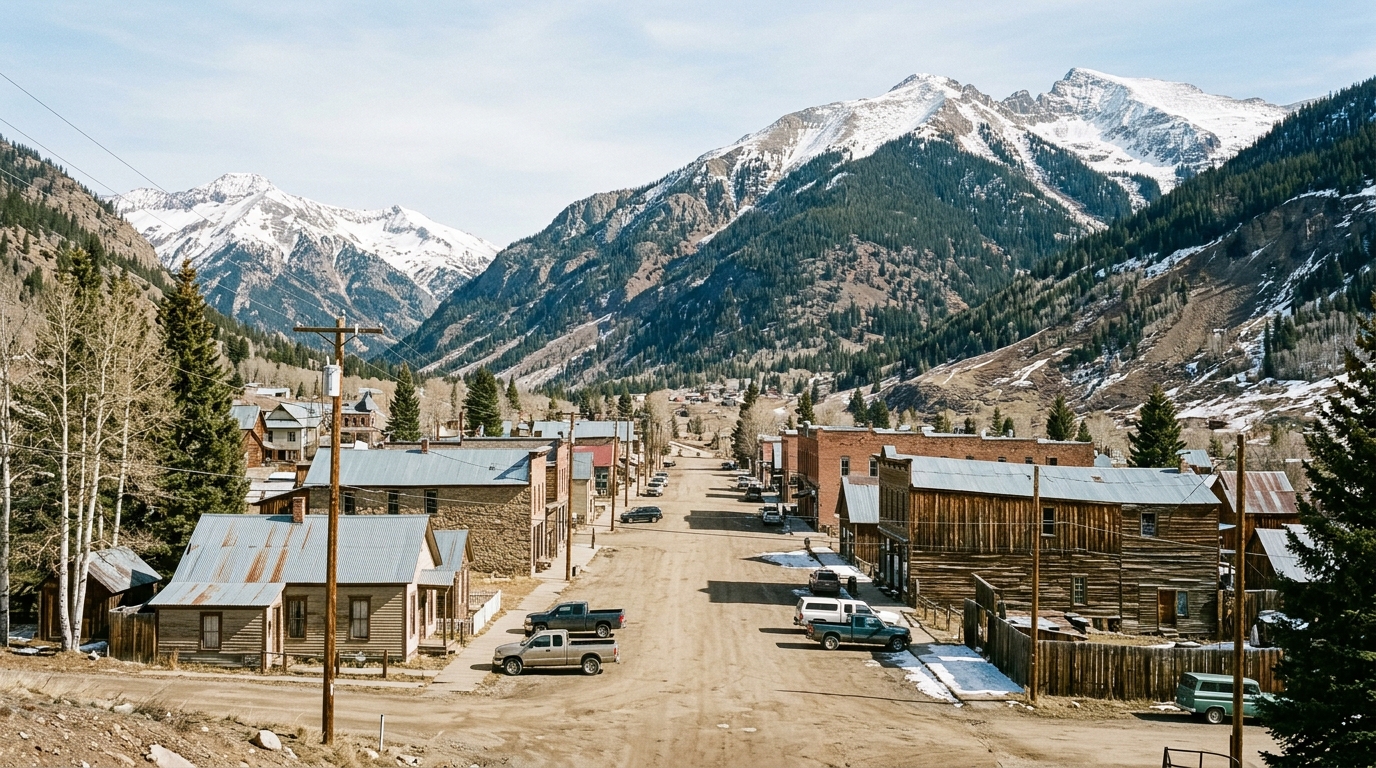
Mountain Rose Realty is a boutique, independent brokerage based in Telluride, Colorado, and Silverton is one of the more distinctive markets we watch across the San Juan Mountains. Buying a home in Silverton Colorado is not the same transaction as buying in Telluride or even neighboring Ouray, because Silverton sits higher, sees harder winters, and operates on a smaller, tighter inventory. This guide walks through elevation, road access, property types, and the year-round versus second-home decision, so you can enter the market with your eyes open. The goal here is plain: give you the specific local factors that change how you should evaluate a Silverton property before you write an offer.
Mountain Rose Realty confirms that buying a home in Silverton Colorado means buying at 9,318 feet in one of the highest incorporated towns in the United States, in a town of roughly 700 year-round residents that is the only incorporated town and county seat of San Juan County (per the Town of Silverton and U.S. Census Bureau). Property inventory is thin and skews toward historic homes, cabins, and vacant lots, so verify winterization, water and sewer connection, and legal access parcel by parcel. Winter road access matters more here than almost anywhere in Colorado: US 550 over Red Mountain Pass closes for snow and avalanche control (per the Colorado Department of Transportation), and the alternate route adds an hour of driving. The single most important first step is to confirm year-round legal and physical access to the specific parcel with San Juan County before you fall in love with a listing.
Mountain Rose Realty finds that Silverton, Colorado real estate rewards buyers who plan for altitude, isolation, and seasonality rather than treating it like a standard mountain-town purchase.
Silverton is a former mining town at 9,318 feet in the San Juan Mountains and the county seat of San Juan County, the highest county by mean elevation in the United States at 11,240 feet (per San Juan County and the U.S. Census Bureau). The town had 622 residents at the 2020 census and roughly 700 year-round today (per the Town of Silverton). Forest Service and Bureau of Land Management (per the Region 9 Economic Development District), private buildable land is genuinely scarce, which shapes both pricing and what comes to market. Buyers should verify three things on every property: winterization and heating systems built for deep cold, water and sewer or well and septic status, and legal year-round access. Silverton is not a resort town like Telluride; it is a working historic community where seasonality drives daily life and property decisions. The practical takeaway is that a Silverton listing needs closer document review than a comparable home in a lower, more connected town. A cabin that shows beautifully in July photos sits behind an unplowed road from November through April.
Mountain Rose Realty notes that Silverton sits at 9,318 feet in the San Juan Mountains of southwestern Colorado, which makes it one of the highest incorporated towns in the United States and the county seat of San Juan County (per the Town of Silverton and the U.S. Census Bureau). That elevation is the single defining fact of the market, and it affects everything from construction to how long your growing season lasts.
San Juan County carries a mean elevation of 11,240 feet, the highest of any county in the country, and it is also the least populous county in Colorado (per San Juan County, Colorado). For a buyer, the low population is not trivia. It means fewer contractors, fewer inspectors, and longer lead times for anything that requires a specialist to drive in from Durango, Montrose, or the Telluride side.
That scarcity of private land is why Silverton inventory stays thin and why vacant, buildable lots inside town limits deserve a hard look at utilities and access before purchase.
The San Juan setting is the draw. Silverton anchors the Alpine Loop, sits at the northern end of the Durango and Silverton Narrow Gauge Railroad, and puts you within reach of terrain that lower towns simply cannot match. The practical trade-off is that the same isolation that protects the scenery also lengthens every errand.
Mountain Rose Realty treats winter road access as the factor that most surprises buyers, because US 550 over Red Mountain Pass between Ouray and Silverton closes during heavy snow and avalanche conditions (per the Colorado Department of Transportation). When it closes, the alternate route via CO 145 over Lizard Head Pass adds an hour of driving, and that hour compounds every time you need groceries, a contractor, or a medical appointment.
The practical decision this forces is honest: how often do you need to leave in deep winter? A retiree who stocks up and stays put experiences Red Mountain Pass differently than a buyer who commutes or runs a business off the mountain. Check COtrip.org, the Colorado Department of Transportation's live conditions site, across a full winter before you assume a route will be reliable on any given morning.
Seasonality also governs when work gets done. Exterior construction, road grading, and many inspections effectively pause in the deepest months, so a lot you buy in September is not buildable until late spring. Budget your timeline around that reality rather than a lowland construction calendar.
For a fuller picture of what daily life at this elevation involves, our notes on living at high altitude in the Telluride region apply directly to Silverton, only more so given the additional altitude.
Mountain Rose Realty sorts Silverton property into a few clear categories: historic in-town homes on the original mining grid, cabins and homes on the outskirts, condominiums and townhome-style units, and vacant lots. Some historic in-town homes are more than a century old, and each category carries a different verification checklist, with the right questions changing by address rather than by a single town-wide rule. San Juan County holds only 622 residents at the 2020 census (per the U.S. Census Bureau), so contractor and inspector lead times run long.
Historic in-town homes are more than a century old, which means the documents to verify are the heating and insulation systems, the water and sewer connection to town utilities, and any historic-district constraints on exterior changes. A charming facade does not tell you whether the mechanicals can hold a house at temperature through a January cold snap.
Cabins and homes outside the town grid shift the key questions to well and septic status, legal access easements, and whether the road is county-maintained or private. On private roads, ask directly who plows, who pays, and whether that arrangement is written down. An unrecorded plowing handshake is not something you want to inherit.
Vacant lots demand the most homework because private land is scarce here. Confirm utility availability, buildable envelope, and year-round legal access with San Juan County before assuming a lot can become a home. Our overview of buying land in the Telluride area lays out the lot-diligence sequence that applies to Silverton parcels as well.
| Property type | What to verify first | Common trade-off | Best fit |
|---|---|---|---|
| Historic in-town home | Heating, insulation, town water/sewer, historic-district rules | Character versus mechanical upgrades | Buyers who want walkable town living |
| Outskirts cabin/home | Well/septic, road maintenance, plowing, legal access | Privacy versus winter logistics | Buyers comfortable with self-sufficiency |
| Condo/townhome | HOA dues, reserves, rental rules, master insurance | Lower maintenance versus association limits | Second-home owners wanting lock-and-leave |
| Vacant lot | Utilities, buildable envelope, year-round access | Lower entry cost versus build timeline/cost | Buyers building to their own plan |
Mountain Rose Realty finds the year-round versus second-home decision is the one that most shapes which Silverton property fits you, because the two uses stress a home in completely different ways. A full-time residence needs to be reliably accessible and comfortable in deep winter; a second home needs to survive months empty without freezing or failing.
Full-time living in Silverton suits people who value a working historic town of roughly 700 year-round residents over resort amenities (per the Town of Silverton). You trade convenience for authenticity: fewer services and longer drives, but a genuine community and terrain that rivals anywhere in the San Juans. The buyers who thrive here plan their winters around Red Mountain Pass rather than fighting it.
Owning a second home shifts the priority to lock-and-leave reliability. If a property sits empty from December to April, freeze protection, monitored heat, and a local person who checks on the house become non-negotiable line items, not luxuries. A townhome or condo with an HOA can simplify this, provided you verify the association actually funds snow removal and building upkeep.
Silverton buyers often compare it against nearby Ouray, a lower and more road-accessible town. If a shorter winter and easier access matter to you, it is worth reading our take on Ouray, the Little Switzerland of America before deciding which San Juan town fits your life.
Mountain Rose Realty approaches a Silverton purchase by front-loading verification, because the factors that make or break a property here, access, utilities, and winterization, are the ones you cannot fix after closing. Working from Telluride and across the San Juan service area, we treat Silverton diligence as address-by-address work rather than a town-wide assumption.
Start by defining your winter tolerance honestly. Buyers who need to leave the mountain often in January should weight Red Mountain Pass reliability heavily; those who settle in for the season can prioritize the house itself. That single question narrows the property search faster than any price filter.
Then match the property type to your use. A retiree wanting walkable town life looks at historic in-town homes; a family building to plan studies vacant lots and their utility access; a second-home owner wanting minimal upkeep leans toward a well-run condo or townhome. Each path has a different document stack, and confirming those documents early prevents a late surprise.
Silverton is not Telluride and it is not Ouray; unlike a resort market, it runs on seasonality and self-sufficiency, and unlike lower valley towns, its winter access can genuinely pause. Buyers who understand that boundary make better decisions. When you are ready to see what is currently on the market, our roundup of recent Silverton listings is a practical starting point, and buyers weighing smaller San Juan towns often also look at Anne-Britt Ostlund's regional real estate background. This is the kind of white-glove, boutique, independent, and unapologetically personal approach that fits a market as specific as Silverton. Unique, like you!
Mountain Rose Realty agent Anne-Britt Ostlund helps buyers and sellers weigh neighborhoods against commute, budget, and daily-routine fit. The service area covers Mountain Village, Ophir, Rico, Silverton, Norwood, and Placerville, and the next conversation can turn school-boundary checks, HOA or metro-district tolerance, and current inventory into a shortlist worth touring.
Mountain Rose Realty answers the questions buyers ask most about Silverton, a town of roughly 700 year-round residents at 9,318 feet (per the Town of Silverton and U.S. Census Bureau).
The town sits within a tight mountain valley, which shapes what can be built and where. Zoning, water rights, and access to utilities vary significantly by parcel, so due diligence on those specifics matters more here than in many other Colorado markets.
US Highway 550 connects Silverton to Ouray to the north and Durango to the south, and both segments are kept open year-round, though winter driving conditions on that corridor can be severe and occasionally trigger temporary closures. Buyers who plan to use a property as a primary residence should factor in what road closures or difficult conditions mean for daily life and emergency access.
Silverton sits at approximately 9,318 feet above sea level, making it one of the higher-elevation incorporated towns in the United States. That elevation affects everything from building costs and insurance to how the body adjusts, and it's worth considering seriously if occupants have any altitude-related health sensitivities.
The inventory in Silverton tends to include single-family homes, a limited number of commercial properties, and occasional vacant land parcels. Historic Victorian-era structures are common given the town's mining heritage, and buyers should anticipate that older homes carry deferred maintenance, outdated systems, or historic designation considerations that affect renovation plans.
Telluride carries a resort-market dynamic with corresponding price points, robust amenity infrastructure, and an active short-term rental economy, none of which defines Silverton to the same degree. Silverton is smaller, quieter, and draws buyers who prioritize a working-town character over ski-resort proximity. The practical trade-off is that financing, insurance, and contractor availability are more complicated in a remote, smaller market, and resale liquidity is more limited than in Telluride.