

September 2023 mortgage-rate archive: this article originally compared the rise in borrowing costs with a long history of 30-year fixed mortgage rates and inflation. The two Keeping Current Matters graphics below preserve that historical discussion. Their words “Today” and “52-Year Average” refer to the charts as published in 2023; they are not current rate quotes.
Freddie Mac began publishing its 30-year fixed-rate mortgage series in April 1971. The original chart labels a peak of 18.63%, an endpoint of 7.18%, and a 52-year average of 7.7%. Those labels help explain why a borrower accustomed to lower rates might experience a payment increase even when a rate sits below a long-run historical average.
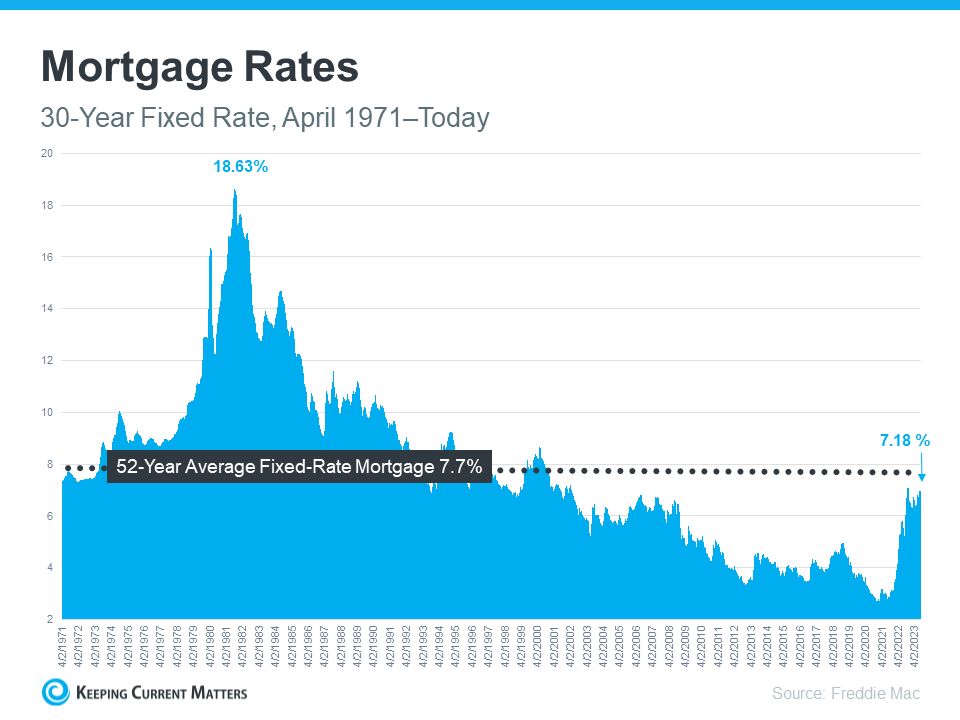
The average in that graphic belongs to its stated historical window and is not recalculated here. Rates did not stay uniformly between 3% and 5% throughout the preceding 15 years. A long-run average also cannot tell you whether a particular loan is affordable.
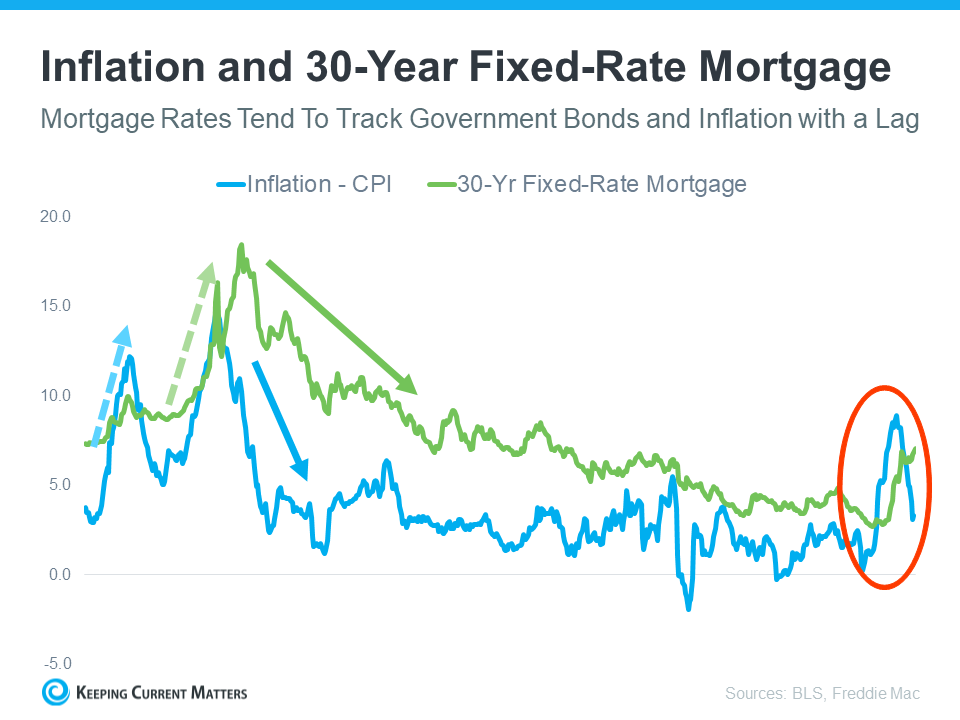
The second graphic compares inflation, labeled CPI, with the 30-year fixed mortgage series. It illustrates historical co-movement; it does not establish a fixed lag, a one-for-one response, or a date when a borrower’s rate will fall. The original expectation of a near-term decline should be read as a September 2023 outlook, not a present recommendation to wait or borrow.
Fannie Mae’s explanation of 30-year mortgage rates describes the role of Treasury yields and mortgage spreads, with expectations about inflation, economic growth and policy influencing bond markets. A Federal Reserve policy-rate change therefore does not translate mechanically into the same change in a mortgage offer.
Freddie Mac’s PMMS page supplies dated national averages and a historical download. Its current methodology uses qualifying loan-application data; the national series is not a Telluride-specific or individual jumbo-loan quote. Use the date and borrower/product scope when comparing it with an offer.
For the inflation series, consult the Bureau of Labor Statistics CPI release and distinguish a change in prices from a change in the inflation rate. Neither national series supplies the complete cost of owning a particular property.
Request current written loan terms for your own purchase, including the payment, fees, cash required, and any lock period. Compare the proposed payment with taxes, insurance, association charges, maintenance, and your other obligations. A purchase should not depend on a promised refinance or rate decline.
Use a spending range supported by your lender discussions and your own budget when comparing Telluride-area properties. Browse listings or contact Anne-Britt Ostlund at Mountain Rose Realty to discuss property criteria and available listing information.