
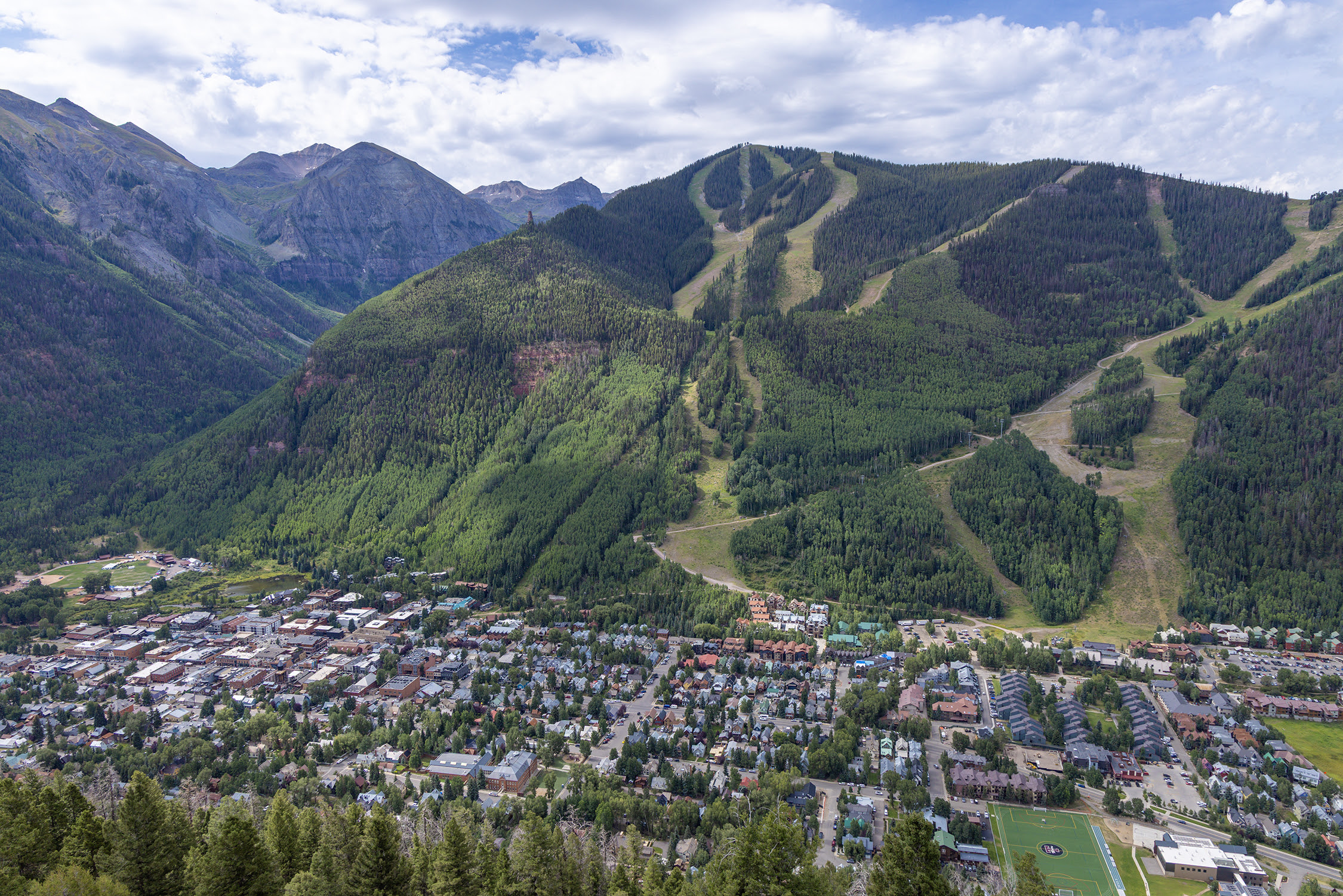
Film Festival weekend is here, fall is beginning to show its colors, and Telluride’s latest air and lodging numbers offer an interesting look at how visitors are planning the months ahead.
For anyone following Telluride Real Estate, tourism and travel trends are worth watching. They don't tell the entire story of our real estate market—far from it—but lodging demand, air access and booking behavior offer useful insight into when people are coming, how far ahead they are planning and what the next season may look like.
This week’s numbers are particularly interesting because the calendar itself is playing a major role in the year-over-year comparisons.
Over the next two weeks, total reported occupancy is currently 44%, compared with 41% during the same reporting period in 2025—approximately 7% ahead year over year.
But there is an important wrinkle in those numbers.
The festival calendar moved this year. The Telluride Film Festival falls entirely in September in 2026, while Telluride Blues & Brews takes place September 18–20, compared with September 12–14 last year.
That means some of the daily and monthly comparisons between August and September aren't exactly apples to apples.
Film Festival and Labor Day weekend is currently sitting at approximately 69% total occupancy, essentially flat to last year.
Considering the shift in dates, a flat year-over-year comparison during one of Telluride's marquee weekends is more useful than simply looking at August or September in isolation.
And, as anyone who has been in Telluride over Film Festival knows, occupancy percentages don't quite capture the energy in town.
For a few days, our little box canyon becomes an unlikely intersection of Hollywood, independent film, mountain culture and locals trying to identify famous people in line for coffee without looking like they're trying to identify famous people in line for coffee.
Very Telluride.
Across the broader summer season, lodging occupancy continues to pace approximately 3% behind 2025, while paid occupancy is down only about 1%.
August closed approximately 12% behind on the reported year-over-year occupancy comparison.
September, however, is currently pacing 4% ahead, while October is approximately 6% ahead.
Again, the movement of major festivals between August and September makes the monthly numbers more volatile than they might initially appear.
Rather than reading August's decline as a standalone indicator of weakening demand, it makes more sense to look at August and September together and consider where the major event weekends landed in each year.
This is an important distinction—and one worth understanding if you're using lodging data to gauge Telluride's tourism economy.
Lodging reports often distinguish between paid occupancy and a broader measure of total occupancy that includes owner-designated dates.
But an owner-designated date does not necessarily mean the owner is physically staying in the property.
Local lodging managers often ask homeowners to provide their personal-use dates well before a season begins. If an owner isn't certain yet—or is waiting for children, family or friends to finalize schedules—they may temporarily block substantial portions of the calendar until those plans are known.
Those dates can therefore represent preemptive owner blocks rather than confirmed owner stays.
As the season approaches and owners finalize their plans, some of that blocked inventory may ultimately be released back into the rental pool.
There's another important caveat: lodging statistics are typically based on participating rental properties and reporting sources. They are not a census of every home in Telluride and Mountain Village, and they do not include homes whose owners do not participate in the rental market. Coverage can also vary among property managers, platforms and booking channels.
In other words:
Paid occupancy is generally the cleaner indicator of actual booked visitor demand, while total occupancy provides additional context but requires a little interpretation.
That distinction becomes especially important when we look ahead to winter.
Winter bookings are still in their early stages, and paid winter occupancy is currently running behind last year.
Reported paid occupancy is approximately:
2026–27 winter: 8.8%
Comparable 2025 period: 9.9%
That's a difference of 1.1 percentage points, or approximately 11% lower year over year.
Meanwhile, reported total occupancy is:
2026–27 winter: 15.3%
Comparable 2025 period: 15.1%
That's essentially flat—just 0.2 percentage points higher.
At first glance, it would be tempting to conclude that owner usage is offsetting softer paid demand.
But given how preseason owner blocks are handled, we shouldn't make that assumption yet.
Some of that difference may simply represent dates being held off the rental calendar while homeowners determine their winter plans.
For that reason, the number I am watching more closely right now is paid occupancy.
And at 8.8% versus 9.9% last year, winter bookings have some catching up to do.
Not necessarily—at least not yet.
Winter booking patterns tend to become considerably more meaningful after Labor Day, when travelers turn their attention from summer vacations to ski season.
The lodging report also notes that some of this year's slower early pace may reflect the challenges of last winter.
Now we get to see what happens as winter marketing ramps up, airline schedules become part of travelers' planning and the ski season moves from “someday this winter” to something people actually put on the calendar.
The next several weeks should therefore give us a much clearer read on winter demand than the current preseason numbers alone.
On the air side, summer bookings remain somewhat softer than 2025.
Overall summer air bookings are currently approximately 3% below last year, with the core June-through-September period approximately 5% behind.
Looking month by month:
July: down approximately 9%
August: down approximately 9%
September: essentially flat
October: up approximately 8%
Labor Day week is currently about 5% behind, while the Telluride Blues & Brews period is pacing approximately 6% ahead.
That October number is particularly interesting.
Telluride's fall season has quietly become one of the most appealing times to be here: fewer crowds, spectacular foliage, cool hiking weather and that brief stretch between festival season and the first snow when the mountains feel distinctly local again.
The winter air schedule is now taking shape, with 14 nonstop flight options connecting the Telluride region with 12 major hubs.
Service through Telluride Regional Airport (TEX) and Montrose Regional Airport (MTJ) provides access from markets including:
Atlanta
Austin
Chicago
Dallas
Denver
Houston
Los Angeles
Nashville
New York/Newark
Phoenix
San Francisco
Overall winter air capacity is expected to remain within approximately 5% of last year's capacity, a solid level of connectivity heading into the ski season.
For a remote mountain destination, that accessibility matters.
Telluride manages to feel wonderfully removed from the rest of the world while still having remarkably good access to it—which is one of the less obvious advantages both visitors and second-home owners quickly come to appreciate.
For the next several weeks, I will be watching three things closely:
1. Winter paid booking pace after Labor Day
This will be far more telling than preseason total occupancy because we should begin seeing actual traveler commitments accelerate.
2. September and October lodging performance
With September currently 4% ahead and October 6% ahead, it will be interesting to see whether fall continues to outperform the softer core summer months.
3. Early winter air bookings
The flights are there. Now the question becomes how quickly travelers begin filling them.
None of these numbers individually predicts what will happen in the telluride real estate market.
But taken together, they help us understand the broader ecosystem surrounding this community—visitor demand, accessibility, seasonal patterns and how people are choosing to spend time in Telluride.
And those are all pieces of the larger story.
For buyers researching telluride homes for sale or comparing homes for sale Telluride CO, statistics like these are useful because owning here isn't simply about purchasing a property.
It's about understanding the rhythm of the place.
Film Festival weekend feels entirely different from an October Tuesday. Christmas week bears little resemblance to late January. Summer festival season, powder days, shoulder seasons and quiet fall afternoons each create their own version of Telluride.
For homeowners—particularly those considering renting a second home—lodging and air data can also provide useful context when evaluating rental expectations, personal-use calendars and ownership strategy.
At Mountain Rose Realty, Anne-Britt Ostlund combines more than two decades of experience in the San Juan Mountains with the market data, local knowledge and real-world context that numbers alone can't provide.
Because understanding Telluride Real Estate requires understanding Telluride itself.