

August 2023 archive: This article originally responded to renewed interest in adjustable-rate mortgages after borrowing costs rose in 2022. Its reassuring headline is not a statement that an ARM is risk-free or suitable for every homebuyer.
An ARM can offer a lower initial rate than a comparable fixed-rate mortgage. That can reduce early payments when fixed rates are higher, but the rate and payment may change after the initial period. Compare actual lender quotes; an initial discount is not guaranteed and does not establish the total cost over the years you own the home.
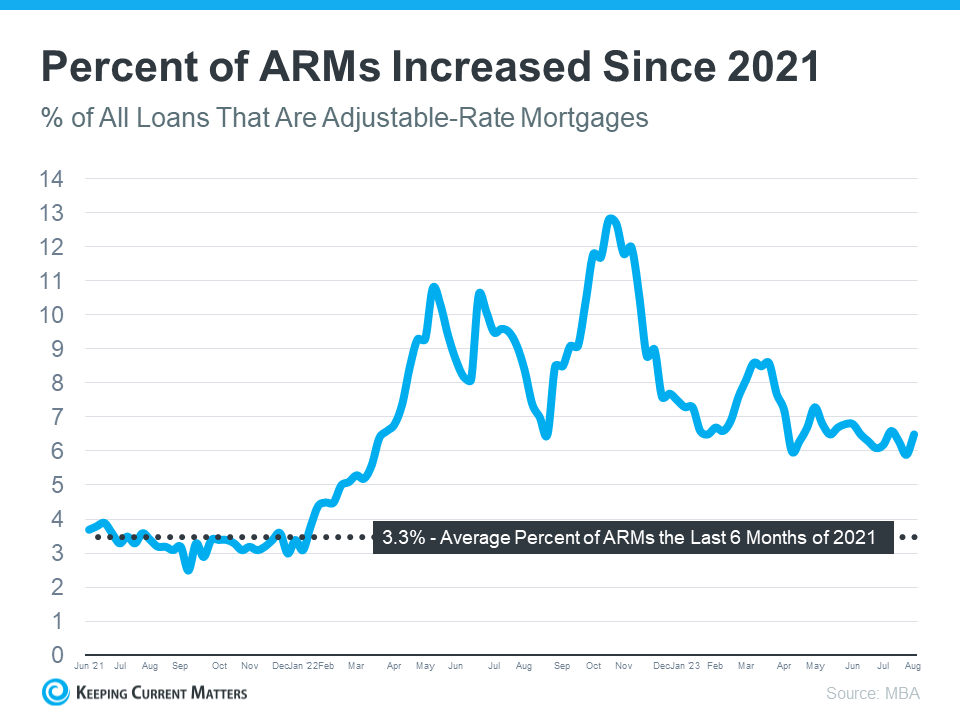
The original MBA-attributed graphic covers June 2021 through August 2023. It labels the average for the last six months of 2021 as 3.3%, shows a rise during 2022 and a lower share again in 2023. Its “percent of all loans” label should not be read as the share of every outstanding U.S. mortgage. MBA's weekly mortgage activity reporting concerns applications, and an application is not a funded loan. The chart does not print an exact value for every point.
The original post cited CoreLogic economist Archana Pradhan's historical comparison: about 60% of ARMs originated in 2007 had low or no documentation, and 29% of ARM borrowers in 2005 had credit scores below 640. These are separate years and measures, not claims about every crisis-era mortgage. The original CoreLogic article is no longer available at its cited URL, so those figures remain attributed historical context rather than newly verified current underwriting statistics.
Documentation and ability-to-repay requirements are important differences from the risky combinations of weak verification, payment shock and unsuitable loan terms seen before the crisis. They do not establish a universal rule that every borrower must have a score above 640, that every ARM has identical terms or that approval proves a payment will remain comfortable.
In a November 28, 2022 analysis, Laurie Goodman, Karan Kaul and John Walsh of the Urban Institute described stronger borrower profiles and longer initial fixed periods among the ARMs they studied. Their favorable comparison with other mortgage products was a research conclusion about that market and sample. It does not remove an individual borrower's exposure to rising payments, job changes or a later inability to refinance.
The Consumer Financial Protection Bureau explains that the rate after the introductory period generally combines an index and a lender-set margin, subject to the loan's caps. Ask how long the initial rate lasts, how often it adjusts, and what the first-adjustment, later-adjustment and lifetime limits allow.
Have the lender show the payment under the allowed increases, including taxes and insurance separately. Compare points, fees, the initial payment and longer-term scenarios with a fixed-rate alternative. Selling or refinancing before a reset is a plan, not a certainty: qualification, property value, transaction costs and available rates may change.
First-time buyers and experienced owners can both benefit from understanding their choices. Anne-Britt Ostlund at Mountain Rose Realty can help with the Telluride property search, while a qualified lender evaluates the financing terms and the borrower's ability to carry them.
For a Telluride purchase or sale, contact Anne-Britt Ostlund at Mountain Rose Realty to compare local properties and coordinate with your lender.