

December 2023 archive: This article discusses a 2023 National Association of REALTORS® (NAR) buyer-services graphic and general purchase-planning questions. Availability, financing, representation terms, and property conditions must be confirmed for a current transaction.
Buying a home involves a sequence of decisions: setting priorities, comparing properties, reviewing documents, arranging financing when needed, and deciding whether to proceed. A broker may help organize a search and explain process choices, but the scope of that help depends on the written brokerage relationship and the particular property.
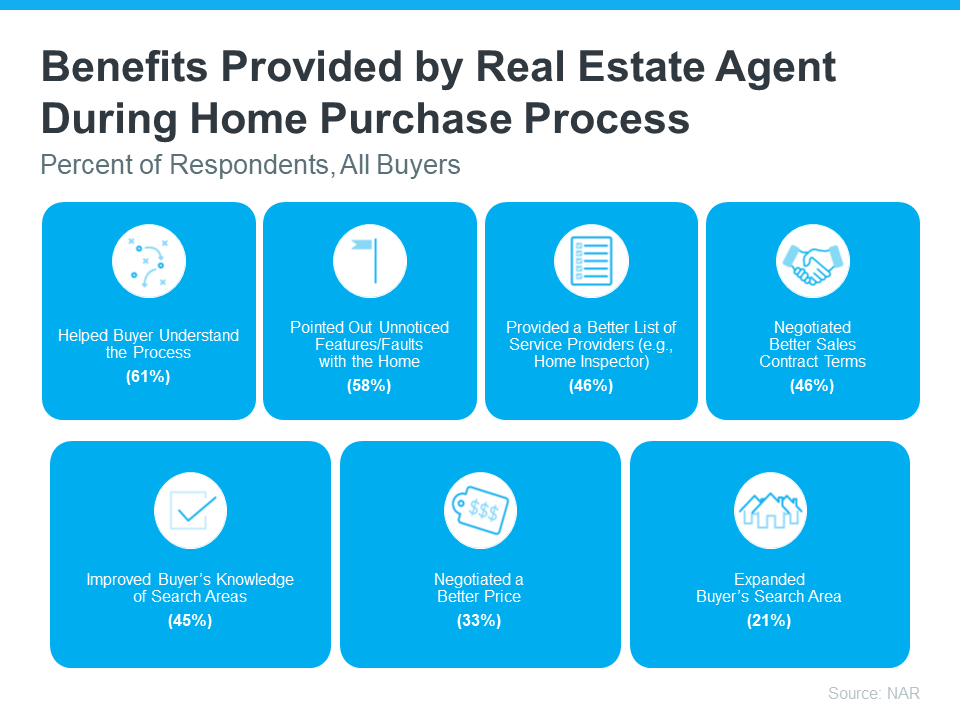
The following NAR graphic is a historical survey graphic labelled “Percent of Respondents, All Buyers.” It reports that 61% cited help understanding the process; 58% cited help noticing home features or faults; 46% cited a better list of service providers; 46% cited better contract terms; 45% cited improved knowledge of search areas; 33% cited a better price; and 21% cited an expanded search area. These percentages describe respondents to that survey; they do not guarantee a result in an individual purchase.
Ask for a written outline of the steps, deadlines, and documents that may apply. An inspection evaluates observable property conditions within its scope. An appraisal is a lender- or buyer-ordered opinion of value for its stated purpose. Neither replaces the other. If financing is planned, ask the lender before making a material credit, employment, cash-reserve, or purchase decision, including an appliance or furniture purchase, because the lender can explain how it may affect that loan file.
A broker can help a buyer prepare questions from a showing and identify issues to investigate. Buyers should still read disclosures, use appropriately qualified inspectors or other specialists, and decide what repair, condition, insurance, access, association, or title questions matter to them. No walkthrough can establish that a property has no defects.
Transaction participants may include lenders, inspectors, appraisers, title professionals, contractors, surveyors, attorneys, and insurance professionals. Ask about each provider’s role, licensing or qualification where relevant, cost, availability, and whether the buyer may choose another provider. A referral is not a promise about price, timing, or work quality.
An offer can involve price, earnest money, financing, inspection, appraisal, title, possession, inclusions, deadlines, and other negotiated terms. A broker may explain available forms and help communicate an offer, but the buyer decides which terms to propose or accept. Legal, tax, and lending questions belong with the appropriate qualified professional.
For a Telluride-area search, compare the actual address and route rather than relying on a broad neighborhood label. Questions can include access in different seasons, utilities, association documents, property use restrictions, parking, transit, service availability, and the distance to the places that matter to the household.
If a first search area does not produce suitable options, revisit the non-negotiables, budget, property type, condition, timing, and geographic boundary. Expanding a search can create additional comparisons; it does not assure that a preferred property or price will be available.
Before engaging a broker, ask whether the proposed relationship is buyer agency, seller agency, or transaction brokerage; what services, compensation terms, and disclosures apply; and which decisions remain yours. Colorado’s Division of Real Estate definitions of working relationships describe a transaction-broker as a neutral facilitator rather than an advocate for either side. A buyer should not assume advocacy or a particular negotiating outcome without the applicable written relationship and agreement.
For a current Telluride-area search, contact Mountain Rose Realty to discuss priorities and ask for the current written relationship disclosures before deciding how to proceed.