
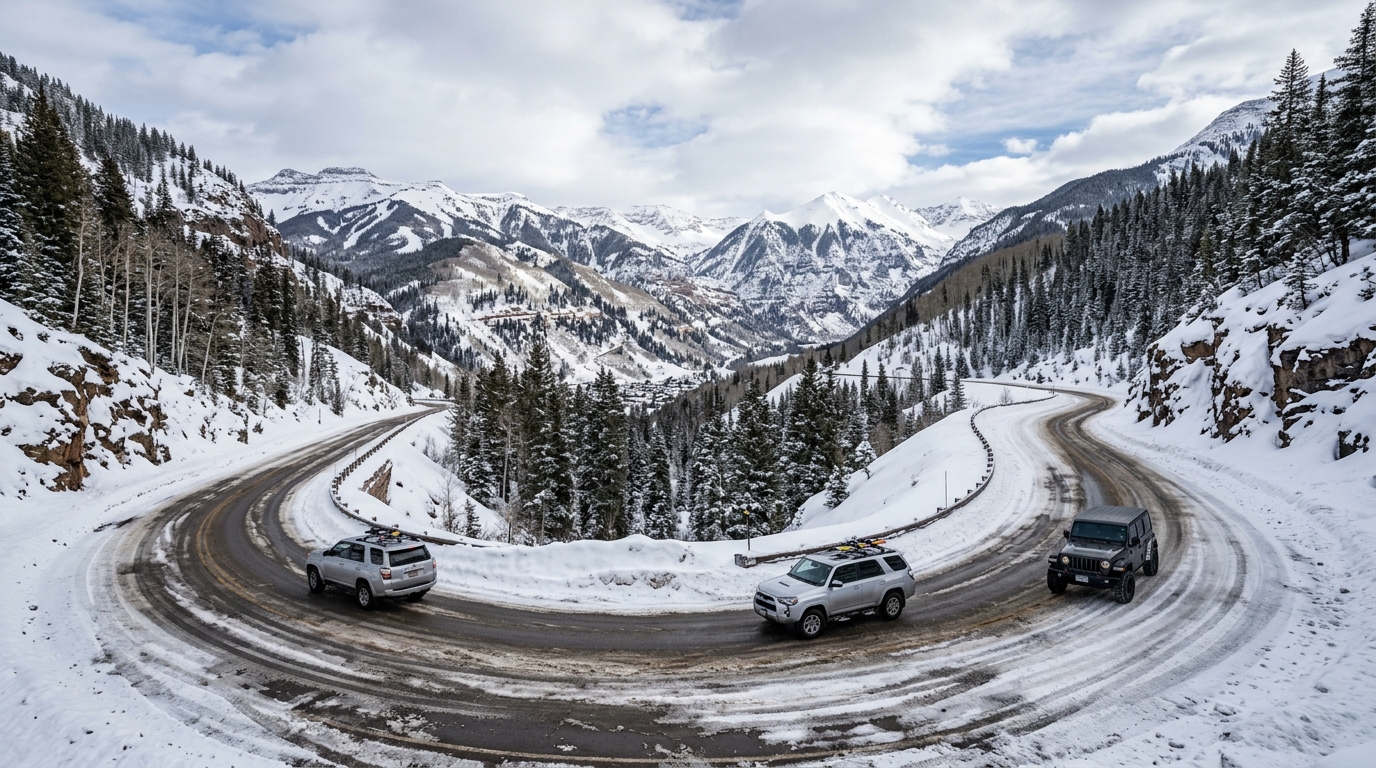
Winter travel is an important property-use question in the Telluride region. Roads, plowing, vehicle equipment, and access responsibility vary by route and address. This guide explains the questions to ask before a winter drive or a property decision; it does not promise a route will remain open, a driveway will be cleared, or a particular vehicle will be suitable in every storm.
Telluride sits at about 8,750 feet in a box canyon. Conditions on the valley floor can differ sharply from a pass, mesa, or driveway. Check COtrip before departure for current restrictions, chain-law activation, closures, cameras, and incidents. Use the route and time you actually plan to drive; a historical description cannot establish present conditions.
CO 145 south crosses Lizard Head Pass, at 10,222 feet, on the route between Telluride and Rico before continuing toward Dolores and Cortez. The pass is maintained as a year-round route, but CDOT may impose temporary restrictions or close it for weather, avalanche work, crashes, or other events. That makes it a route to check, rather than a route to assume will be open on a particular morning.
The northern connection follows CO 145 through Placerville, CO 62 over Dallas Divide, and US 550 toward Ridgway and Montrose. It is a distinct route with its own grades, curves, wind, maintenance work, and weather exposure. It should not be described as universally safer, lower-risk, or more reliable than Lizard Head. Compare current COtrip information, your vehicle, daylight, destination, and the forecast before choosing either route.
Vehicle access to Mountain Village uses Mountain Village Boulevard, the Telluride spur off CO 145, and local streets; the gondola is a separate passenger connection. Winter vehicle access remains address-specific. A route to a neighborhood does not establish the condition of a private driveway, parking area, shared road, ski access, or walking route. Aldasoro Ranch is separate from Mountain Village; do not treat its access or service arrangements as Mountain Village municipal service.
CDOT activates traction or chain restrictions for particular conditions and corridors. Its current Traction Law page describes qualifying passenger-vehicle configurations, including AWD or 4WD with qualifying M+S, winter, or all-weather tires and at least 3/16-inch tread depth, or chains or an approved alternative traction device. When the passenger-vehicle chain law is in effect, CDOT states that every vehicle must have chains or an approved alternative traction device. Read the active restriction and the detailed CDOT chain-law rules for the applicable configuration rather than relying on a generalized drivetrain rule.
The 3/16-inch tread measure should not be described as a new 2025 threshold. The current page calls its configuration a Fall 2025 update; Colorado’s 2019 House Bill 1207 is relevant historical statutory context. For an actual trip, the posted restriction and COtrip are controlling practical sources.
Snow tires, chains, and AWD or 4WD can improve capability in some conditions, but none eliminates the need for speed, visibility, route, brake, driver-experience, and weather judgment. A buyer or visitor should choose equipment with the vehicle manufacturer, tire provider, and current CDOT requirements in mind.
Responsibility changes at the boundary between a highway, municipal street, county road, shared access road, and driveway. CDOT maintains state highways such as CO 145, CO 62, and US 550. Municipal governments maintain their own public streets under their current service rules. San Miguel County Road and Bridge states that it maintains county roads and is not responsible for private roads, state highways, or city roads; see the county’s Road & Bridge information.
A private driveway or shared access road can be governed by an owner, HOA, road-maintenance association, easement agreement, contractor, or another recorded arrangement. Do not assume that every unincorporated road is privately plowed, or that a county-maintained route reaches the home. For a specific address, read the recorded access and maintenance documents, ask who authorizes and pays for plowing, confirm the trigger and service schedule, and ask what happens during a long storm or contractor delay.
A managed in-town property may place some walkway, parking, snow-removal, or exterior responsibilities with an HOA, while the Town maintains public streets. That can reduce some individual tasks, but it does not establish the lowest ownership burden or cost. Review dues, reserves, service scope, parking, entry, storage, roof, insurance, and any special-assessment exposure. Price per square foot alone does not determine winter cost.
Mountain Village properties can involve municipal streets, private drives, association rules, steeper grades, parking arrangements, and snow-removal contracts. Confirm the actual driveway and parking responsibility, the HOA’s services and exclusions, access from the stated route, and whether the property’s planned use changes the practical questions.
Outlying and mesa properties may have more distance, exposure, shared-road arrangements, gates, wells, septic systems, or private snow-removal needs. Those features can be valuable to a household seeking space or privacy, but they are not a categorical burden or benefit. Confirm access, easements, maintenance, snow-removal agreements, turnaround space, emergency access, utilities, and the vehicle expected to reach the property under ordinary and storm conditions.
Highway, municipal, county, HOA, and private obligations differ.
Review: Plat, title documents, recorded easements, HOA or road-association documents, and the responsible agency.
Service scope and priority determine more than a broad neighborhood label.
Review: Written service terms, contractor, trigger depth, priority, cost, and any owner duties.
Grades, exposure, turns, and closures vary by address and destination.
Review: COtrip, route mapping, current road notices, daylight needs, and a site visit when conditions permit.
Legal traction restrictions and actual driveway conditions can differ.
Review: Manufacturer guidance, tire condition, active CDOT restriction, chains or approved device, and safe storage.
Snow work, equipment, HOA services, and repairs belong in the ownership budget.
Review: HOA budget, road assessments, plowing quotes, tires, insurance, fuel, maintenance, and contingencies.
An absent owner may need a clear arrival and service plan.
Review: Monitoring, contractor access, parking, arrival timing, snow removal, and any property-use restrictions.
Winter access is one part of the property comparison alongside title, use restrictions, utilities, insurance, taxes, association obligations, condition, financing, and timing. It is relevant to a residence, second home, rural parcel, or property with an accessory unit, but it does not by itself decide suitability or value. For broader context, see the 2026 Telluride market guide and the guide to buying a Telluride property with an existing ADU.
If you are evaluating a specific Telluride-area address, contact Mountain Rose Realty with the address and intended use. We can help identify current public records, HOA or road-association questions, and the items to verify with the applicable owner, manager, agency, contractor, lender, title professional, inspector, attorney, or insurance provider.
Mountain Rose Realty serves Telluride, Mountain Village, Ophir, Rico, Silverton, Norwood, Placerville, Ridgway, and nearby areas. For a current property question, use the contact page, call (970) 759-4886, or email ab@MountainRoseRealty.co. You can also read about Anne-Britt Ostlund for the brokerage’s local profile.