

Presented by Mountain Rose Realty and Anne-Britt Ostlund. This is a historical report edition covering February 2026, with February 2025 comparisons. Read the original luxury market report for its full market coverage and definitions. The edition month and the period measured are different.
The original article cited Mordor Intelligence’s North American luxury residential market estimate: $583.94 billion for 2025, $606.84 billion for 2026 and a forecast of $735.48 billion by 2031, with a 3.92% compound annual growth rate for 2026–2031. This is a provider’s modeled market-size estimate and forecast, with its own coverage and assumptions. It does not say the 2026 market was already above $700 billion or that a Telluride home should appreciate 3.92% annually.
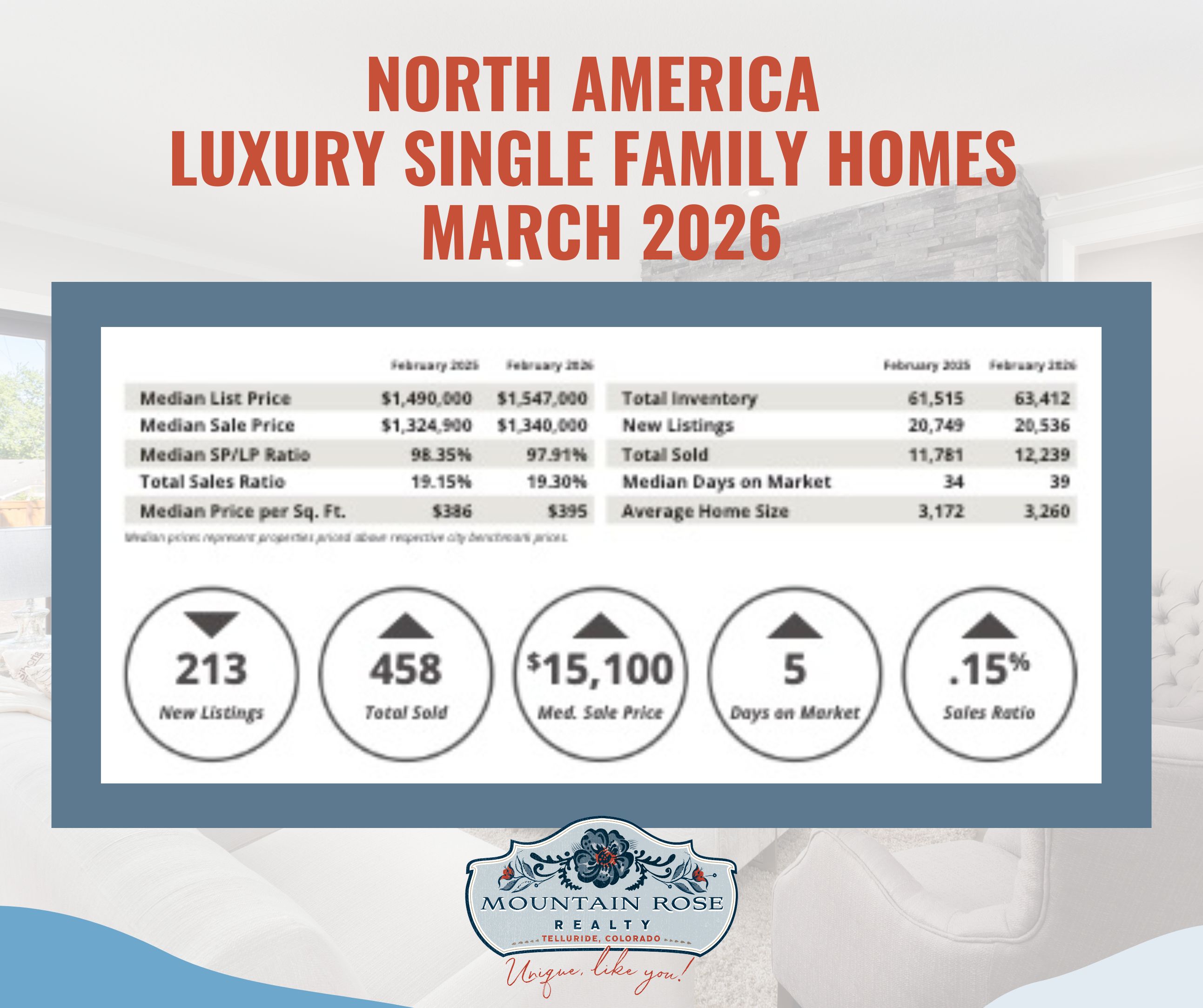
Calculated from those displayed counts, sales rose about 3.9%, inventory about 3.1% and the median sale price about 1.1% year over year. Those changes describe this dataset and comparison period, not a guarantee of stable values across every market.
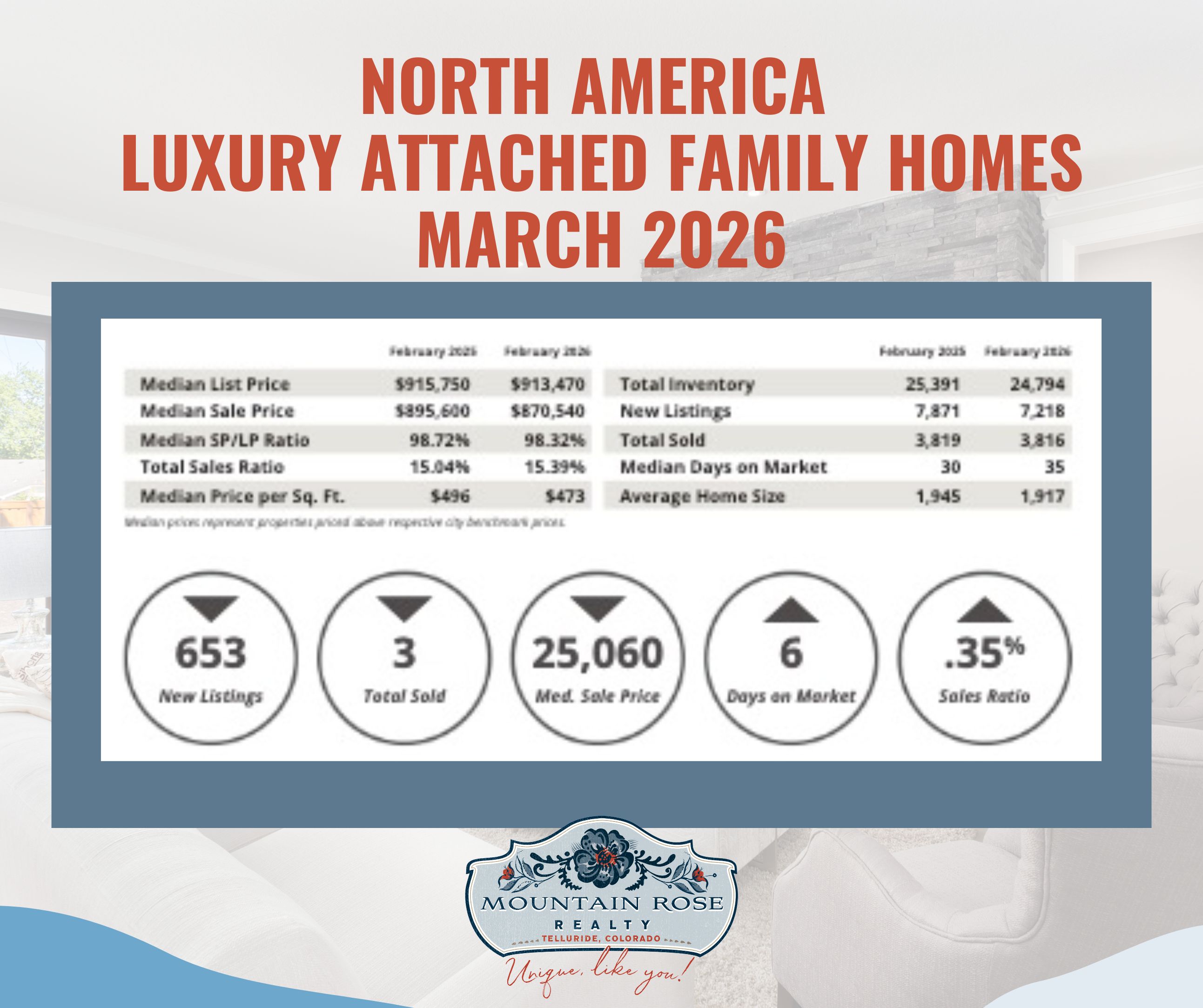
The displayed values imply a roughly 2.8% decline in median sale price, a 2.35% decline in inventory and nearly unchanged sales year over year. The 15.39% sales ratio corrects the earlier article’s approximately 13% statement. Both categories fall within the report’s balanced range.
Chart correction: the attached graphic’s days-on-market callout shows an increase of six, but 35 minus 30 is five days. This text uses the displayed table values. A 0.35-point increase in the sales ratio is a percentage-point difference, not a 0.35% relative increase.
The original report’s March 2026 narrative gives additional comparisons: over two years, single-family luxury prices rose roughly 3% and attached prices roughly 4.5%. It reports January-to-February 2026 sales increases of 18.9% and 21.2%, respectively, while median prices rose 2.3% for single-family homes and fell 9.1% for attached homes. Those are separate periods from the year-over-year tables above. The report interprets the attached price movement partly in terms of transaction mix, not uniform losses on individual homes.
The report also discusses larger transactions above $10 million, $20 million and $50 million and themes of lifestyle, privacy and long-term ownership. These are the publisher’s market interpretation, not a promise of performance or evidence that every affluent buyer behaves alike. The earlier article’s roughly $5.9 million Telluride figure needs its own property segment and sample before it can inform a local valuation.
Privacy, security, wellness space, indoor-outdoor design, room for extended family and remote work can be useful search criteria. Treat them as preferences to discuss, not measured characteristics of every affluent buyer. Cash purchasers remain exposed to carrying costs, liquidity needs and changing property values even without a mortgage.
The Institute for Luxury Home Marketing uses market-specific luxury thresholds and selected markets across the United States and Canada. This is not a census of every North American home. A median describes the middle of the reported observations and can change when the mix of homes sold changes; it does not measure appreciation of the same properties.
Sales ratio compares reported sales with inventory. The Institute labels ratios below 12% a buyer’s market, 12% to below 21% balanced, and 21% or more a seller’s market. A ratio over 100% can occur when sales during the reporting period exceed the inventory snapshot. It does not mean homes sell that percentage faster, and it is not a price-growth rate.
Use the Institute’s report description for source context. Its underlying data come from several sources and are not guaranteed. The figures here are reported historical statistics, not independently reconstructed MLS results.
For a purchase or sale, compare current closed transactions and competing listings in the relevant location, property type and price band. Review condition, access, parking, maintenance, association finances and any rental restrictions separately. A report’s market label does not establish the negotiating room, rental permission or future value of an individual home.
Contact Anne-Britt Ostlund at Mountain Rose Realty to discuss the property and the evidence needed for your decision.