
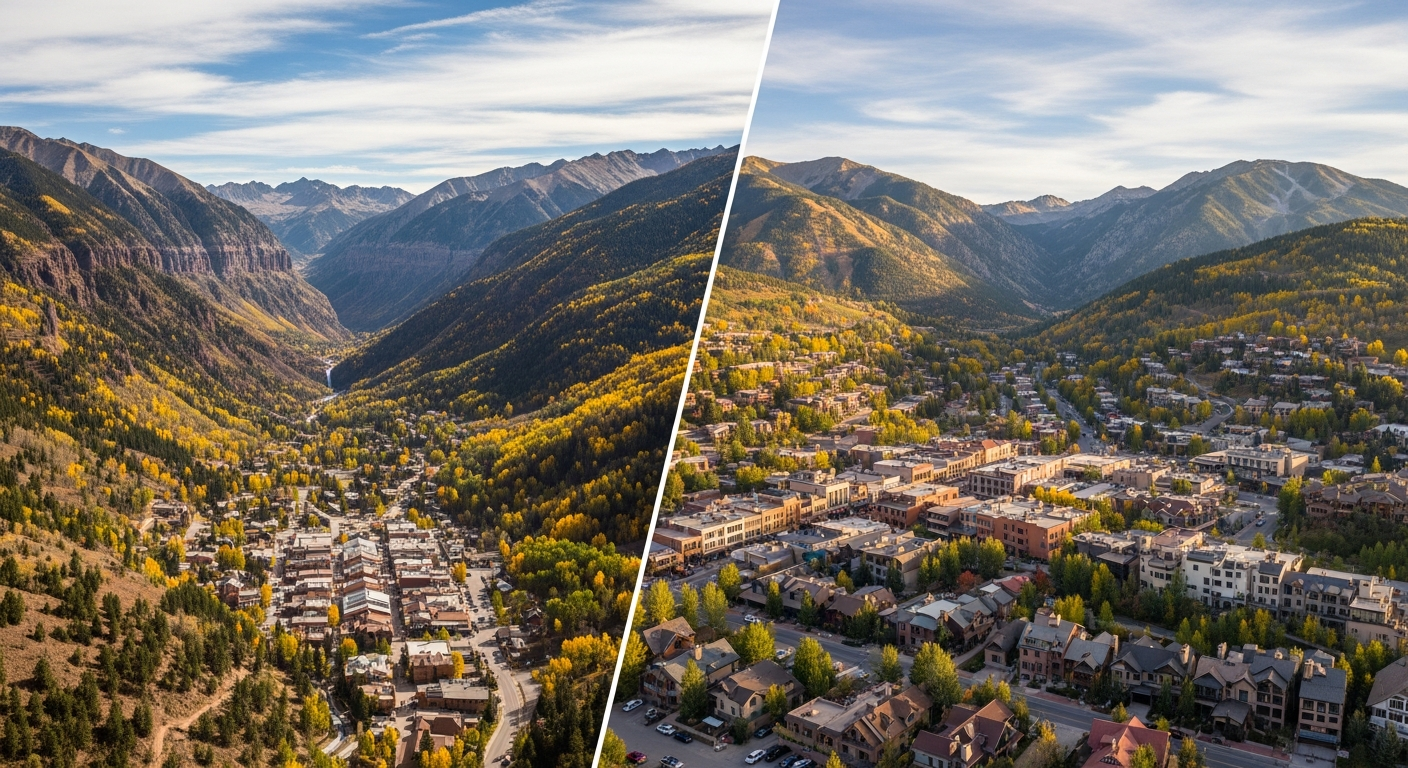
Telluride and Aspen both offer mountain-town homes, ski access, arts programming and properties used as primary or second homes. Choosing between them starts with how you will use a property: the trips you will make, the terrain you want to ski, the neighborhood you prefer and the costs you can carry. A market’s reputation is less useful than a comparison of homes that actually meet those needs.
Compare geography, access, inventory, price, lifestyle, skiing, property types and representation separately. For market statistics, ask for the same reporting period and clearly defined geographic boundaries. A broad regional reputation cannot establish the number, price or resale prospects of the homes that fit your search.
Telluride occupies a box canyon in the San Juan Mountains. The historic town, Mountain Village and the surrounding mesas offer different settings; they should not be treated as one interchangeable neighborhood. Highway 145 provides the principal paved approach, with the spur into town ending in the canyon. Seasonal high-clearance routes are not substitutes for an ordinary all-season arrival road. Check the route and current road conditions for the particular property.
Aspen sits in the Roaring Fork Valley. Highway 82 links the area with communities down-valley, including Basalt and Carbondale, while Snowmass Village is a separate resort community reached by its own approach. Independence Pass is seasonal. A property’s postal address, municipality, commute and winter route matter more than whether a listing is loosely described as “Aspen area” or “Telluride area.”
The two regions also have different airport choices. Aspen/Pitkin County Airport (ASE) serves Aspen and the surrounding area. Telluride Regional Airport (TEX) has scheduled service as well as private aviation; describing it as only a private-aircraft alternative would miss a real travel option. Montrose Regional Airport (MTJ) provides another commercial gateway to Telluride. Visit Telluride’s arrival guide places Montrose approximately 65 miles away and explains the need for a ground transfer.
A nonstop flight depends on the origin, season, day and airline. It is not accurate to assume that every Telluride trip requires a connection or that every Aspen trip offers a nonstop. Compare the actual itinerary for your usual travel dates, the last available flight, baggage arrangements and the transfer to each candidate home. Weather can affect flights and roads in either region. A quoted drive time is an estimate, not a reliable door-to-door guarantee.
For frequent travel, test a realistic arrival and departure plan before buying. A short map distance may still involve a transfer, a seasonal service gap or a difficult winter driveway. For a longer seasonal stay, those same details may matter less than the neighborhood and daily experience once you arrive.
Descriptions of Aspen as a deeper market or Telluride as a smaller pool of tightly held homes should be tested for the actual search. Aspen city, Aspen/Snowmass, Pitkin County and the broader Roaring Fork Valley are different geographic samples. The Town of Telluride, Mountain Village, San Miguel County and nearby San Juan communities are also different samples.
For an inventory comparison, use the same observation date, price range and property type, and separate active, pending and sold properties. Exclude fractional interests or deed-restricted homes if the buyer’s intended use cannot qualify. An active-listing count measures available choices at that moment; it does not establish annual transaction volume, liquidity or the future resale prospects of a particular home.
Telluride’s canyon setting and Mountain Village’s planned development shape the choices a buyer can consider. They do not establish that every listing will be scarce or appreciate. A narrow brief, such as a restored historic home within a defined walking distance or a particular type of ski access, can yield few candidates in either region. Broaden one requirement at a time so the trade-off is visible: neighborhood, lot size, renovation tolerance, access or budget.
If a suitable home is not available, decide what evidence would justify waiting and what would justify considering another location. Do not assume that patience will be rewarded financially, that every Aspen buyer can choose among ten suitable homes, or that every Telluride buyer will see only one or two. Use the current search results to set expectations.
Both regions include luxury homes. A comparison of the $25 million-plus segment, or of how much land and interior space the same budget buys, needs dated listing and closed-sale evidence. A headline sale, asking price or exceptional estate cannot establish the typical value of a market. Asking prices also need to remain separate from closed prices.
Build the comparison around individual properties with relevant closed sales. Compare usable interior area, lot characteristics, condition, views, access, renovation constraints and location. Price per square foot can help organize similar homes; it does not capture differences in land, historic character, layout or the cost of work. State the period and number of sales behind any median or average, especially in a small luxury segment.
Then compare carrying costs: actual property-tax records, insurance quotes, utilities, HOA dues, reserve funding, special assessments, snow removal and maintenance. Request property-specific estimates for needed repairs. Mountain construction logistics can affect a project, but a generic claim that renovation is expensive is no substitute for an inspection, scope and contractor quote.
Sharing a state does not make two properties’ taxes equivalent. Assessed values, taxing districts, classifications and municipal transfer rules can differ. Consult the relevant county records and the City of Aspen’s tax information or the Town of Telluride’s tax information for the applicable jurisdiction. A nearby address may fall outside that city or town. Have the closing team verify which charges and exemptions apply to the transaction.
Aspen is often described as international and Telluride as quieter. These impressions are not rules about residents or reliable measures of privacy. Neither community has a single buyer profile, dress code or reason for living there. Experience both during the season when you would actually use the home, including busy event weeks and quieter periods.
Telluride’s historic core is a concrete feature: the Town documents its National Historic Landmark District and preservation process. Victorian-era buildings, the street grid and the surrounding canyon give an in-town search a distinct setting. Historic designation can also affect alteration plans, so character and renovation flexibility should be considered together.
Aspen event examples include the Aspen Ideas Festival, Food & Wine Classic, Aspen Music Festival and X Games at Buttermilk. Telluride examples include the Telluride Film Festival, Telluride Bluegrass Festival and Mountainfilm. These names help identify the kinds of programming to research; dates, locations, tickets and future editions should be checked with the organizer. A festival list does not prove that one place has a larger or better cultural calendar.
Walk from each candidate home to the restaurants, groceries, galleries and transit stops you would use. Consider seasonal hours, noise, stairs, deliveries and parking. A desirable downtown location for one buyer may feel too busy to another. Privacy depends on the particular site, neighboring properties and usage, not a market-wide promise.
Aspen Snowmass comprises Aspen Mountain, Aspen Highlands, Buttermilk and Snowmass, with lift-ticket options covering all four. They are distinct ski areas, so moving among them requires ground transportation rather than a single continuous lift network. Verify the inclusions and restrictions of the exact ticket or pass you plan to buy.
Snowmass offers a broad mix of terrain, Buttermilk includes learning areas and terrain parks, Aspen Highlands includes the hike to Highland Bowl, and Aspen Mountain is known for intermediate and advanced skiing. These broad descriptions are starting points, not a guarantee that a particular run is suitable or open. Match the current map and conditions to the people using the home.
Telluride Ski Resort connects the town side and Mountain Village within one ski area. The free public gondola connects the communities during its operating seasons, with maintenance closures. Public gondola transportation does not replace the lift ticket required for skiing.
The resort’s terrain ranges from beginner and intermediate runs to demanding upper-mountain terrain, including Gold Hill and the Palmyra Peak hike. See Forever is an intermediate ski trail, as described by Visit Telluride’s skiing guide; it should not be grouped with steep hike-to ski terrain. Summer hiking ratings and winter ski ratings are different. Use the resort’s current winter map and operating information for the actual route.
For any home advertised with ski access, walk the route and identify the lift, gradient, road crossings, easements and return path. “Ski-in/ski-out,” “near the lift” and “gondola access” describe different experiences. Access may depend on snow, open terrain or a shuttle, and the easiest route for an expert may not suit a beginner or a child.
The Aspen comparison includes downtown condominiums, estate homes and properties in areas such as Red Mountain, Starwood and Woody Creek, with ranch and larger-parcel searches extending toward Old Snowmass and the valley. Snowmass Village adds its own condominiums and homes with resort access. These locations have different travel patterns and land-use rules; they should not be combined into a single price expectation.
In the Telluride region, the historic town includes older homes, condominiums and infill development. Mountain Village includes ski-access and golf-area properties. Aldasoro, Telluride Ski Ranches and Hillside offer different residential settings, while Wilson Mesa and Hastings Mesa are relevant to some larger-parcel searches. It would be inaccurate to treat all of these neighborhoods as ranch land or promise acreage at every address.
Lawson Hill and other down-valley options require attention to deed restrictions and eligibility where applicable. Ridgway, Ouray and Placerville broaden the location choices, but their commute, services and market evidence differ. They are not simply cheaper substitutes for an equivalent in-town property. Verify each property’s use restrictions, access, utilities, water arrangements, HOA documents and development potential.
A downtown-condominium buyer can compare actual walking routes and building finances. A historic-home buyer should investigate preservation requirements and condition. A ski-access buyer should verify the route in winter. A ranch or land buyer needs parcel-specific access, utility and land-use diligence. The property type determines the questions in both regions.
Private introductions can be part of a property search. Their share of a market cannot be established without a defined period, transaction count and clear definition of an off-market sale. A broker relationship may lead to a seller-authorized introduction, but it does not guarantee access to undisclosed homes or establish that private offerings are better priced.
Use public listings and relevant closed sales as part of the search, and ask a representative to explain how any additional opportunity became available, what the seller has authorized, what information can be shared and how compensation and representation work. A property’s absence from a portal is not evidence of exclusivity or value. Apply the same inspection, title, financing and price analysis to a private introduction.
A buyer who wants to rotate among four ski mountains may prefer the Aspen Snowmass arrangement. A buyer drawn to Telluride’s canyon setting, historic core and town-to-village gondola may prefer that geography. Neither preference determines investment performance, social identity or the number of suitable homes available at a specific budget.
Compare a short list using the same criteria: actual travel itinerary, neighborhood, daily walking or transit needs, ski access, property condition, ownership costs and intended use. Visit during the relevant season and identify the compromises you would make in each place. The better fit is the home and location that support those plans within the budget, with risks you understand.
Anne-Britt Ostlund and Mountain Rose Realty work with buyers considering Telluride, Mountain Village and the surrounding region. For a comparison, bring the budget, preferred dates of use, travel origin, property type and non-negotiable requirements. Ask for current listings and clearly scoped comparable sales rather than a promise about appreciation or unavailable inventory.
Contact Anne-Britt at Mountain Rose Realty or call 970-759-4886 to discuss the Telluride side of your search. The brokerage’s profile describes more than 20 years of experience, more than $150 million closed and participation in the REALM global network. These are brokerage-reported credentials; the home search itself should be grounded in current property evidence.