
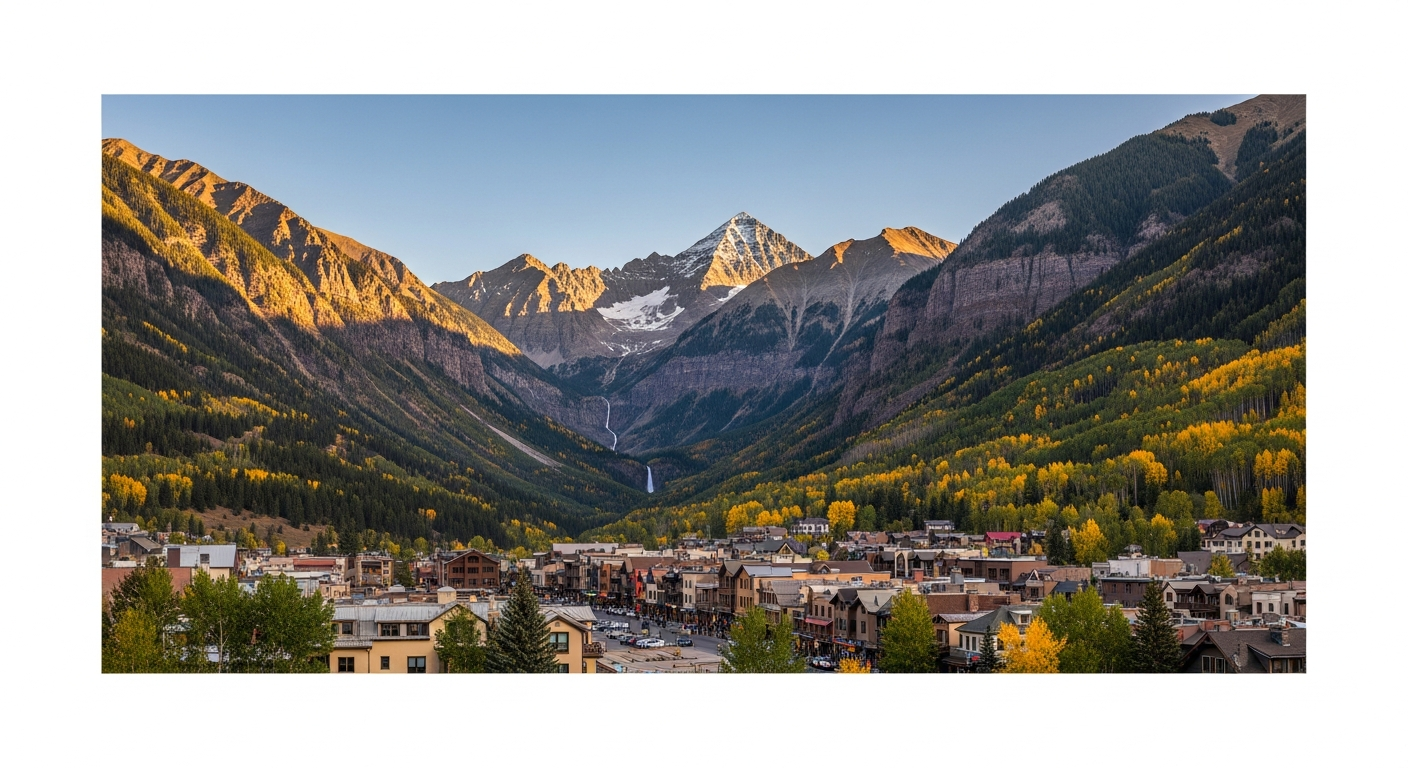
Living in Telluride means making a home in a glacial box canyon in the San Juan Mountains, with a working historic downtown beneath dramatic peaks. The Town of Telluride is commonly described at about 8,750 feet; Mountain Village is higher, at about 9,545 feet. The difference is roughly 795 feet, and both are high-altitude communities. The daily experience includes skiing, summer trails and festivals, quieter shoulder seasons, travel planning and the ordinary routines of a small town.
I encourage prospective full-time residents to look beyond a favorite vacation week. A home that works for ski holidays may have different access, upkeep and neighborhood considerations when it becomes your year-round address.
The alpine comparison is easy to understand from the landscape: Ajax Peak, Telluride Peak and Ballard Mountain frame the canyon, with Bridal Veil Falls, described by the tourism board as a 365-foot waterfall at its head. The steep San Juan scenery and Mountain Village's European-style pedestrian core give the nickname its appeal. The description is a visual comparison, not a verified account of the nickname's origin or the ancestry of the mining population.
Telluride's municipal history records its emergence as a town in 1878 and the core area's designation as a National Historic Landmark District in 1961. That is different from dating the National Register of Historic Places designation to 1961. The area's history also extends before the mining town; the Telluride Historical Museum provides a starting point for its documented history.
Mountain Village's own history dates county approval of its planned development to December 22, 1981, creation of the metropolitan district to 1983 and municipal incorporation to March 10, 1995. Its founders envisioned a pedestrian-friendly European-style resort village with a commercial center, homes, trails and workforce housing. The village's planning history supports that architectural comparison without requiring an unsupported story about Swiss, Tyrolean, Austrian or Italian mining families.
Sleeping elevation and the elevation of an outing are different. The ski resort's mountain information distinguishes lift-served terrain from higher hike-to terrain, including Palmyra Peak at about 13,150 feet. A day on the upper mountain is not the same exposure as staying in Town.
The CDC's altitude guidance says unacclimatized travelers can develop illness around 8,000 feet or sometimes lower. Its acute acclimatization period is roughly 3–5 days; other adaptation continues longer. There is no universal two-to-six-week deadline for complete adjustment, and fitness does not eliminate altitude risk. Gradual ascent and a slower first couple of days can help.
Discuss heart, lung or sleep-related conditions with a clinician familiar with altitude before a move or extended stay. Do not treat breathlessness at rest, confusion or difficulty walking as ordinary adjustment; seek urgent medical help. A real-estate guide cannot determine whether a particular address is medically suitable.
Dry air and stronger sunlight deserve practical attention too. Use the daily UV forecast and plan sun protection for skin and eyes, including on snow. EPA explains that UV intensity increases by about 6% per kilometer of elevation, not the previously stated 7–10% per 1,000 feet. Weather, time of day and reflective surfaces also affect exposure.
No. A 2009 study by David Faeh, Felix Gutzwiller and Matthias Bopp, published in Circulation, found lower coronary-heart-disease and stroke mortality associated with higher elevation in its Swiss cohort. It examined residents aged 40–84 at 259–1,960 meters. Telluride and Mountain Village are approximately 2,667 and 2,909 meters, above that study's range. The observational association cannot establish that moving here improves an individual's cardiovascular health. The earlier version of this guide incorrectly named the journal and also cited a 2014 U.S. study that could not be verified; neither supports a health-benefit promise for a home purchase.
The useful calendar is a planning framework, not a promise that weather or businesses will follow fixed dates.
For a resident, the point is practical: know where you will shop, which restaurants are open, how to get to appointments and what recreation remains accessible during an off-week. The quieter calendar can be an attraction in its own right, but it should be part of the decision before closing.
Town of Telluride has a compact historic street grid and Colorado Avenue commerce, with the library, post office, courthouse, groceries, restaurants and other services nearby. Historic-district review can affect exterior changes and construction. Walkability depends on the address, grade, snow and individual needs. Some Town homes also have direct walking access to ski facilities; it is incorrect to say all residents must drive to a lift.
Mountain Village offers a planned resort setting, a pedestrian core and many newer residences, with ski access at some properties. A Mountain Village address does not automatically mean ski-in/ski-out. Confirm the actual route, lift operation, grade and seasonal access at each home. Association obligations may include a building or neighborhood HOA and the Telluride Mountain Village Owners Association, or TMVOA; read the property's governing documents and assessments.
Do not assume Town homes have no HOA obligations or that every Mountain Village service is operated by an owners association. TMVOA, the municipal government and regional transit providers have different roles. The Town's gondola page provides current operating information. The free connection between Town and Mountain Village commonly takes about 13 minutes, with posted hours often around 6:30 a.m. to midnight during operating seasons. Maintenance shutdowns and weather interruptions matter; the Town's 2026 spring notice describes SMART replacement buses during that closure.
Both communities are served by Telluride R-1 schools and the region's transportation and medical network. The Telluride Regional Medical Center provides primary care and 24/7 emergency and trauma services. It should not be presented as a full-service inpatient hospital; confirm specialist, ongoing-care and transfer arrangements for your household.
For some households, the choice centers on walking to dinner and errands; for others it is slope access, the home layout, outdoor space or building services. There is no verified basis here for saying families split evenly or retirees usually choose Town. Walk both communities in more than one season and compare what a normal weekday would require.
The 2020 Census place table counts 2,607 residents in Telluride and 1,264 in Mountain Village, a combined 3,871. These are April 2020 census counts, not current estimates or a count of everyone physically present throughout the year. San Miguel County's 2020 population was 8,072, including these towns and communities such as Norwood, Sawpit, Ophir and unincorporated areas.
Visitors and second-home use influence the rhythm of restaurants, traffic, parking, groceries and staffing. However, a unit that is not owner-occupied may be a full-time rental, and vacancy, second-home status and short-term-rental licensing are separate measures. The earlier claim that about 60% of units were second homes or short-term rentals, and that peak population was five to seven times the resident count, was not established by the cited material. Use a current housing study or licensing inventory for those specific questions.
The mountain setting, trails and ski terrain are only part of the choice. Altitude, maintenance, neighborhood access and the off-season calendar deserve the same attention as a favorite festival or powder day.
For a candid conversation about Telluride and Mountain Village, contact Anne-Britt Ostlund at Mountain Rose Realty on (970) 759-4886. Explore the Telluride community page, Mountain Village community page and current listings. The Telluride versus Aspen guide and ADUs in Telluride guide cover related decisions.
Anne-Britt is the broker-owner of Mountain Rose Realty. Her brokerage profile describes more than 20 years in the Telluride and Mountain Village markets and membership in REALM Global and the Institute for Luxury Home Marketing. Read her background for the professional context behind this local perspective.